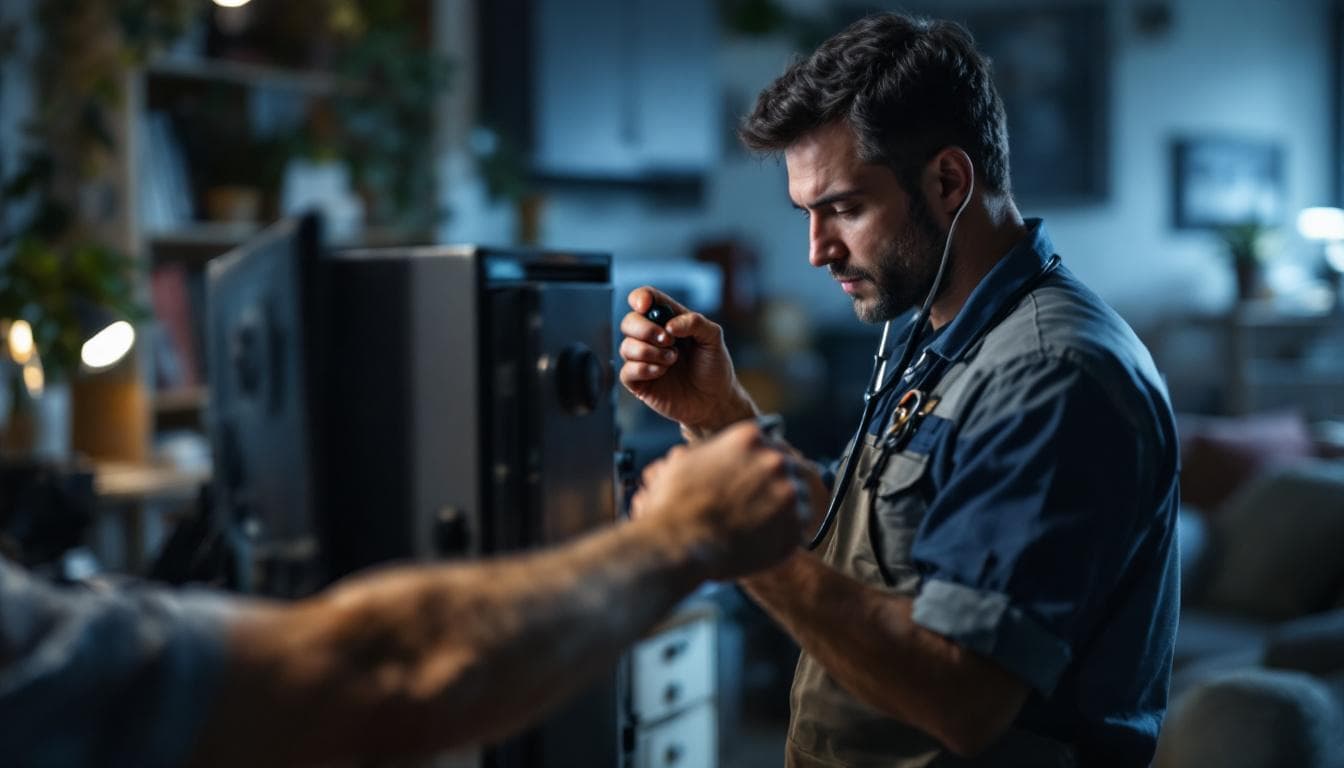
Safe lockouts are distinctly different from door lockouts — they involve a specialized combination of mechanical knowledge, patience, and in some cases, precision drilling. They are also more emotionally charged: the contents of a safe are typically items of significant value, whether financial, sentimental, or legal.
This guide covers the realistic options for safe opening in the Inland Empire, what the different methods involve, and what they cost.
Why Safes Lock Out Their Owners
Forgotten combination. The most common scenario — particularly for safes that are accessed infrequently. A combination written down somewhere that cannot now be found, or one never committed to memory because "I'll never forget this."
Electronic lock failure. The safe's electronic keypad malfunctions, becomes unresponsive, or shows a fault code. This may be a dead battery (often solvable without a locksmith), a failed keypad, or a failure in the lock mechanism.
Dead battery. Electronic safe locks are battery-powered — typically 4 AA batteries. A completely dead battery disables the keypad. Most electronic safes have an external 9-volt override terminal for exactly this reason (see below).
Lost key (key-lock safes). Some safes use a traditional key as the primary credential or as a secondary factor alongside a combination. A lost key requires either picking, decoding, or creating a new key.
Jammed or worn mechanism. Dial combination locks with worn components, or electronic locks with mechanical bolt issues, may prevent opening even when the correct combination is entered.
Unauthorized access attempt. Some electronic safes enter a lockout mode after multiple incorrect entry attempts, requiring a reset procedure before any further attempts are allowed.
The 9-Volt Battery Override: Try This First for Electronic Safes
If your electronic safe is showing no display, no response to keypad presses, or a low battery indicator:
- Obtain a fresh 9-volt battery (Energizer or Duracell)
- Look for an external battery override port on the front panel of the safe — it is often a recessed contact or small terminal, sometimes hidden under a sticker or cover plate
- Hold the 9-volt battery's terminals firmly against the override contacts
- While maintaining contact, enter your combination on the keypad
- The brief external power boost provides enough energy for the electronic lock to process the entry
This resolves a meaningful percentage of electronic safe "lockouts" that are simply dead-battery situations. It costs $3 and takes two minutes. Try it before calling anyone.
Safe Opening Methods: Non-Destructive to Destructive
Method 1: Electronic Override Codes
Most quality electronic safe locks (LaGard, Securam, Sargent & Greenleaf) have factory override codes or a reset procedure accessible to safe technicians. This is the ideal outcome — the safe is opened, no damage occurs, and a new combination is set.
Cost: $95–$145
Method 2: Dial Combination Manipulation
For mechanical dial safes, a skilled safe technician can "manipulate" the combination by listening for the mechanical feedback of the cam and disc stack as the dial is turned. This is time-intensive (30 minutes to several hours depending on lock complexity) but leaves the safe and lock completely intact.
Cost: $150–$250
Method 3: Scoping
A small bore is drilled through the safe body (not the door) to insert a fiber-optic camera, allowing the technician to visually observe the dial's cam stack and determine the combination. The bore is repaired after opening.
Cost: $175–$300 (includes bore repair)
Method 4: Drilling (Last Resort)
When manipulation fails and scoping is not practical, drilling the lock mechanism provides access. This damages the existing lock but does not damage the safe body or door, allowing a new lock to be installed.
Cost: $195–$400 (includes new lock installation if desired)
Method 5: Forced Opening
For very old, low-security safes — fireproof file cabinet safes, small gun safes, bargain home safes — forced opening may be more practical than technical manipulation. Not applicable to quality security safes.
Combination Changes: After Opening
Once a safe is opened, we can reset the combination to any code you choose:
Electronic lock reset: New master code and user code programmed to your specifications. Takes 5–10 minutes.
Mechanical dial reset: The dial lock is physically reset to a new combination. We document the new combination and provide written record.
Safe Types We Service in the Inland Empire
Residential fireproof safes: Common brands — SentrySafe, First Alert, Honeywell. Typically lighter-security electronic or dial locks.
Residential security safes: Higher security models from Liberty, American Security (AMSEC), Browning.
Gun safes: Long gun and handgun safes from Liberty, Stack-On, Cannon, Fort Knox, Browning.
Commercial cash safes: Cannon, Gardall, Diebold, Mosler models used in retail and office environments.
Floor safes: In-concrete floor safes common in older IE residential and commercial properties.
Wall safes: Typically lighter-gauge with standard combination or electronic locks.
High-security bank-grade safes: Diebold, Mosler, S&G. These require advanced techniques and significantly higher service time. We assess before quoting on this category.
What We Cannot Open
Locked safety deposit boxes from financial institutions — these are federally regulated and require bank procedures with proper authorization documentation.
Safes for which we cannot establish ownership through documentation — we require proof of ownership before any safe opening service.
Call (909) 935-8844 for safe opening and combination change service across all Inland Empire cities. Provide the safe brand and model when calling so we can confirm service capability before dispatch.
What the Industry Data Says
Safe service is a specialized subset of locksmithing, with credentialing handled separately from general residential and automotive work. ALOA operates a Safe and Vault Technicians Association (SAVTA) division that issues a separate Certified Safe Technician (CST) credential beyond the basic Registered Locksmith credential[^savta]. Underwriters Laboratories publishes the burglary and fire ratings (UL TL-15, TL-30, RSC, etc.) that classify safes by their resistance to attack, and the National Association of Insurance Commissioners notes that homeowner's insurance jewelry, firearm, and cash coverage limits often vary directly with the UL rating of the safe storing the items[^naic-home].
"Safe work is the area of locksmithing where the difference between a credentialed technician and an amateur is most visible. A correctly opened safe leaves no damage to the lock, the boltwork, or the safe body. An amateur opens it once and destroys $800 to $4,000 in safe value doing it."
— Clyde Roberson, CML, Master Locksmith and longtime industry educator
What to Do Right Now
- Do not attempt to drill or pry the safe yourself. A correctly opened safe is reusable; a destroyed safe is scrap.
- Locate documentation if you have it — the original combination card, manufacturer documentation, or model number stamped on the door. Cuts service time and cost.
- Call (909) 935-8844 for credentialed safe opening and combination change. SAVTA-trained technicians, on-site across the Inland Empire. CA License #LCO 7776.
Common IE Safe Service Categories
Safe work spans a wider range of jobs than most consumers expect. The categories we see most often in the Inland Empire:
- Lost combination on a residential floor or wall safe. Owner inherited the safe, forgot the combination, or never had it. Service runs $185 to $385 depending on safe brand and rating.
- Combination change on a working safe. Owner has the current combination and wants to change it (typically after a move, after employee turnover for a small-business safe, or as a security refresh). Service runs $95 to $185 for most mechanical-dial residential and small-commercial safes.
- Electronic-keypad battery failure. The keypad has gone dark and the safe will not open. In most cases the battery is on the keypad housing and can be replaced from outside without opening the safe — service runs $65 to $145. In some lower-grade safes, the battery is inside the safe body, which requires a full opening procedure.
- Boltwork failure on a commercial safe. The boltwork mechanism that drives the locking bolts has failed mechanically — the dial turns, the combination is correct, but the bolts don't retract. Service runs $245 to $485 depending on safe complexity.
- High-rated burglary safe (UL TL-15 or TL-30) opening. UL-rated burglary safes are designed to resist forced opening; even a credentialed technician opening one without the combination requires a longer, more careful procedure. Service runs $385 to $785.
What the UL and BHMA Ratings Mean for Your Insurance
Most homeowner's policies and small-business commercial policies tie cash, jewelry, firearm, and collectibles coverage limits directly to the UL rating of the safe storing them. Specifically:
- No UL rating — most policies treat the contents as if they were stored loose in the home (i.e., minimal coverage above the per-item or per-category cap).
- UL RSC (Residential Security Container) — modest increase in coverage limits; common for entry-level gun safes and home safes.
- UL TL-15 (Tool-Resistant, 15 minutes) — meaningful increase in coverage limits for cash and jewelry, typical for high-value home safes and small-business retail safes.
- UL TL-30 — significant coverage increase; standard for jewelry retailers, cash-handling businesses, and high-value private collections.
- UL TRTL-30x6 — top-tier; required by most insurance carriers for major cash-handling businesses (banks, coin dealers, etc.).
If your homeowner's insurance covers $5,000 in jewelry "in any container" but $25,000 in jewelry "in a UL TL-15 or better safe," the rating of your safe is functionally an insurance decision as much as a security decision. Review the policy details before assuming your existing safe is sufficient for the items inside.
Sources
[^savta]: Safe and Vault Technicians Association (a division of ALOA), https://www.savta.org/
[^naic-home]: National Association of Insurance Commissioners — Homeowners insurance, https://content.naic.org/consumer/home-insurance.htm
Frequently Asked Questions
Can a locksmith open a safe without the combination?
Yes, depending on the safe type and model. Dial combination safes can often be opened through manipulation or drilling with minimal damage. Electronic safes may have override procedures or battery replacement solutions. High-security safes may require drilling, which permanently affects the safe door.
How much does safe opening cost in the Inland Empire?
Lock Busters charges $95–$195 for most residential safe openings using non-destructive methods. Safes requiring drilling start at $195–$350. Commercial high-security safes vary significantly by model. We provide an estimate after identifying the safe model.
Can you change a safe combination after opening?
Yes. After opening, we can reset the combination on most dial and electronic safes. Electronic safes receive a new master and user code. Dial safes are physically reset to a new combination of your choosing.
What should I do if my electronic safe shows a dead battery?
Most electronic safes have an external 9-volt battery contact on the front panel for exactly this situation. Place a fresh 9V battery against the terminals while entering your combination — the brief power boost typically allows the lock to open. Try this before calling a locksmith.
Can a locksmith open a floor safe or wall safe?
Yes. Floor safes and wall safes present some access challenges compared to freestanding safes, but we service all types. Floor safes often require lying-down access and specialized manipulation tools. Wall safes are typically more accessible.