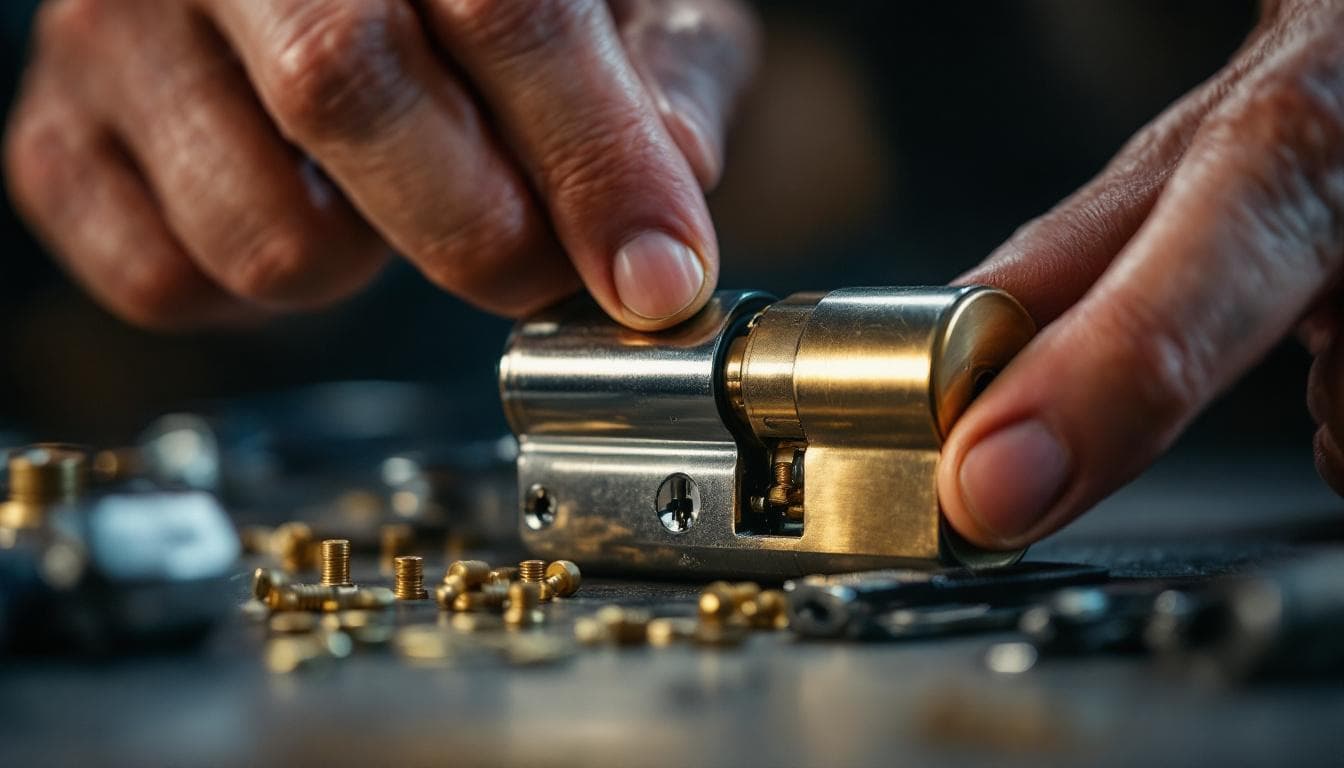
"I want to rekey my locks" is one of the most common requests we receive at Lock Busters across the Inland Empire. But for many homeowners, rekeying is a somewhat mysterious process — they know they want it done but are not entirely sure what it means.
This guide demystifies rekeying completely. What it is, exactly how it works at a mechanical level, when it makes sense versus replacement, and what you can expect during the service.
What Is a Lock, and How Does It Work?
To understand rekeying, you need a basic understanding of how a pin-tumbler lock works — the type used in the vast majority of residential deadbolts and door knobs across the Inland Empire.
Inside your lock cylinder is a series of vertical chambers (usually 5 or 6). Each chamber contains a pair of spring-loaded pins:
- Key pin (lower pin) — contacts the key when inserted
- Driver pin (upper pin) — sits above the key pin, pressed by a spring
When no key is inserted, the driver pins cross the "shear line" — the boundary between the rotating cylinder and the fixed housing — preventing the cylinder from turning.
When the correct key is inserted, the cut pattern lifts each key pin to a different height. The cuts are precisely calibrated so that every key pin rises to exactly the shear line, pushing each driver pin fully above it. With all driver pins above the shear line, the cylinder rotates freely. The lock opens.
The wrong key lifts pins to incorrect heights. Some driver pins remain below the shear line, blocking rotation. The lock stays locked.
What Rekeying Actually Changes
Rekeying replaces the key pins (the lower set) with pins of different heights. The new pin heights correspond to a new key cut pattern.
After rekeying:
- The original key's cuts no longer align with the shear line at any chamber
- The new key's cuts align precisely across all chambers
- The hardware itself — the cylinder housing, the bolt mechanism, the external hardware — is completely unchanged
- The security level is identical to a brand-new lock of the same model
Rekeying takes approximately 20 minutes per lock. It requires no special installation and leaves the door hardware exactly as it was.
The Step-by-Step Rekeying Process
Here is exactly what happens during a professional rekey service:
Step 1 — Remove the lock cylinder from the door. For a deadbolt, this typically means removing a tailpiece or set screw and withdrawing the cylinder. For a knob lock, the knob assembly is removed to access the cylinder.
Step 2 — Use a plug follower tool to remove the cylinder plug. The plug is the rotating inner portion. A specialized tool holds the spring-loaded pins in place during removal.
Step 3 — Remove the existing key pins. Using a rekeying kit (brand-specific — Schlage, Kwikset, Defiant, and others all use slightly different pin sizes and spacing), the existing key pins are identified and removed.
Step 4 — Decode the new key. If you are providing a specific key to match (for example, a house key you want all locks to match), the locksmith reads the cut depths on that key and selects the corresponding pin heights from the rekeying kit.
If no reference key is provided, the locksmith selects a new pin combination, cuts new keys to that combination, and provides them to you.
Step 5 — Install the new key pins. New pins of the correct heights for the new key pattern are inserted into each chamber.
Step 6 — Reassemble and verify. The cylinder is reassembled, reinstalled in the lock, and tested with both the old key (must not turn) and the new key (must turn and operate the bolt smoothly).
When Rekeying Is the Right Choice
Rekeying is the correct service when:
- You have moved into a new home (resale or new construction)
- You have given out copies and want a clean key control situation
- You have ended a relationship with someone who had a key
- A key was lost or stolen and you want to neutralize it
- You want all your doors to work on a single key without replacing hardware
- Your existing lock hardware is in good condition and meets your security needs
When Full Replacement Makes More Sense
Replacing the lock entirely is better when:
- The existing hardware is worn, binding, or mechanically compromised
- You are upgrading from Grade 2 or below to Grade 1 security hardware
- You want to add smart lock functionality
- The lock shows signs of tampering, picking, or drilling attempts
- You are doing a general home renovation and want matching new hardware throughout
All Locks to One Key: The Convenience Rekey
One of our most popular services in the Inland Empire is rekeying all exterior locks to a single key. This is called a "master key" or "single key" rekey.
Instead of carrying separate keys for the front door, back door, side entry, and garage access door — all matching hardware within the same brand family can be rekeyed to the same key cut pattern. One key for everything.
Limitations: This works within the same lock manufacturer family. Schlage to Schlage, Kwikset to Kwikset. Cross-brand rekeying to a single key is not mechanically possible due to different cylinder specifications.
What a Professional Rekey Service Costs in the Inland Empire
Lock Busters residential rekeying rates:
- Service call fee: $55–$75
- Per lock rekey: $25–$45
- 3-bedroom home (5–6 exterior locks): $200–$345 all-in
- 4-bedroom home (7–8 exterior locks): $265–$435 all-in
- Single-key matching: Included — no additional charge
All new keys are cut on-site. We provide the exact number of key copies you request. Service is completed in a single appointment.
Call (909) 935-8844 for same-day rekeying service across all Inland Empire cities.
What the Industry Data Says
Rekeying is one of the oldest and most thoroughly standardized procedures in the locksmithing trade. The ANSI/BHMA A156.5 standard for auxiliary locks specifies the dimensional tolerances and cylinder design that make pin-tumbler rekeying possible across virtually every residential and light-commercial lock sold in the United States[^bhma-a156]. ALOA's Fundamentals of Locksmithing curriculum dedicates an entire module to rekey theory, including the math of how 5- and 6-pin tumbler combinations generate the roughly 1 million unique key codes used in standard Kwikset and Schlage residential cylinders[^aloa-curriculum]. The Builders Hardware Manufacturers Association estimates that more than 95 percent of residential pin-tumbler locks installed in the U.S. since 1980 are field-rekeyable by a credentialed locksmith without specialized factory tooling[^bhma-residential].
"Rekeying is one of the highest-value services a homeowner can buy because the per-lock cost is a fraction of replacement and the security outcome is identical. The mechanical cylinder doesn't know whether the pins were changed yesterday or 10 years ago."
— Lloyd Seliber, master-keying specialist and longtime industry instructor
The Procedure, Step by Step
A standard residential rekey takes 10 to 20 minutes per lock and follows a tightly defined sequence:
- Cylinder removal. The locksmith removes the lock cylinder from the door without damaging the door, the lockset trim, or the surrounding hardware.
- Plug extraction. The cylinder plug — the rotating cylindrical core that the key enters — is removed from the cylinder housing using a follower tool to control the upper pins and springs.
- Pin recombination. The existing bottom pins are removed and replaced with a new combination of pin lengths that corresponds to the new key cut.
- Reassembly and test. Plug returns to housing, cylinder returns to door, new key tested for smooth operation, old keys verified to no longer operate the lock.
The combination of pins is calculated against the bitting of the new key — there is no guesswork. A correctly performed rekey is functionally indistinguishable from a brand-new cylinder.
What to Do Right Now
- Inventory every exterior lock that should accept the same key. Most homeowners want all exterior doors keyed alike for convenience — confirm this before the locksmith arrives.
- Save the spare keys somewhere predictable. Three keys per house is a sensible standard — one in your daily pocket, one in a hidden but secure outdoor location, one with a trusted family member.
- Call (909) 935-8844 for same-day rekey service. $20 to $40 per cylinder, on-site, across the Inland Empire. CA License #LCO 7776.
When Rekeying Is the Right Call vs When It Isn't
Rekeying is the high-value answer when the existing lock is in good mechanical condition. It is the wrong answer in three specific scenarios:
- The lock is damaged. Cracked housing, bent strike plate, severely worn keyway, or visible pry-marks from a prior attempted break-in. The cylinder may rekey successfully, but the lock as a whole has lost its security margin.
- The lock is Grade 3 or unrated. Builder-grade hardware on an exterior door is undersized for residential security regardless of how new the pin combination is. Rekeying it preserves a weak point.
- You want to upgrade the system. Moving from a single-cylinder to a double-cylinder deadbolt, adding a smart lock, or consolidating your keys onto a master-key plan — all require new hardware, not just a rekey.
In every other case — good-condition Grade 2 or Grade 1 hardware, no damage, no upgrade plan — rekey is the right call. The math is straightforward: $20 to $40 per cylinder for a rekey vs $80 to $250 per cylinder for replacement.
Master-Keying for Inland Empire Homeowners with Multiple Properties
If you own rental property in the IE — a duplex in San Bernardino, a single-family rental in Fontana, a vacation cabin in Big Bear — a master-key plan can let you carry one key that opens every property while each tenant carries a key that opens only their unit. ALOA's Fundamentals of Locksmithing curriculum dedicates a separate module to master-keying theory because the system has to be designed in advance — you cannot just add master-key capability to a random rekey after the fact.
The most common IE master-key plans:
- Single master with multiple change keys. One landlord key + one tenant key per unit. Works for 2 to 20 units.
- Two-level system. A "grand master" for owner access + a "sub-master" for the property manager + change keys for individual units. Standard for 20+ unit buildings.
- Construction master. A temporary key used during construction or turnover, which is automatically rendered inoperable when the permanent change key is used the first time. Useful for new builds and renovation projects.
Master-key system design is paid as a one-time service ($150 to $400 depending on size); the per-lock rekey cost stays the same.
Sources
[^bhma-a156]: Builders Hardware Manufacturers Association — ANSI/BHMA A156.5 standard, https://www.buildershardware.com/
[^aloa-curriculum]: Associated Locksmiths of America — Fundamentals of Locksmithing curriculum, https://www.aloa.org/training/
[^bhma-residential]: BHMA residential lock-market data, https://www.buildershardware.com/
Frequently Asked Questions
What exactly happens when a lock is rekeyed?
The locksmith removes the lock cylinder, disassembles the pin stack inside, and replaces the driver and key pins with a new combination. The result: the old key no longer operates the lock, and a new key cut to the new combination does.
Is rekeying as secure as replacing the lock?
Yes — the security level of a rekeyed lock is identical to a brand-new lock of the same hardware. The rekeying process does not degrade lock security. What you are changing is the key, not the bolt or the housing.
How much does rekeying cost versus replacing a lock?
Rekeying a lock costs $25–$45. A full lock replacement with new Grade 1 hardware costs $80–$175 installed. Rekeying makes financial sense when the existing hardware is in good condition and meets your security standard.
Can all my home locks be rekeyed to one key?
Yes — and this is one of the most popular requests we receive. We can rekey all your exterior locks (front, back, side, garage access) to work on a single key. This works within the same lock brand family.
How long does rekeying take?
Approximately 15–25 minutes per lock. A typical 3–4 bedroom Inland Empire home with 5–7 exterior locks takes 60–120 minutes for a complete rekey.