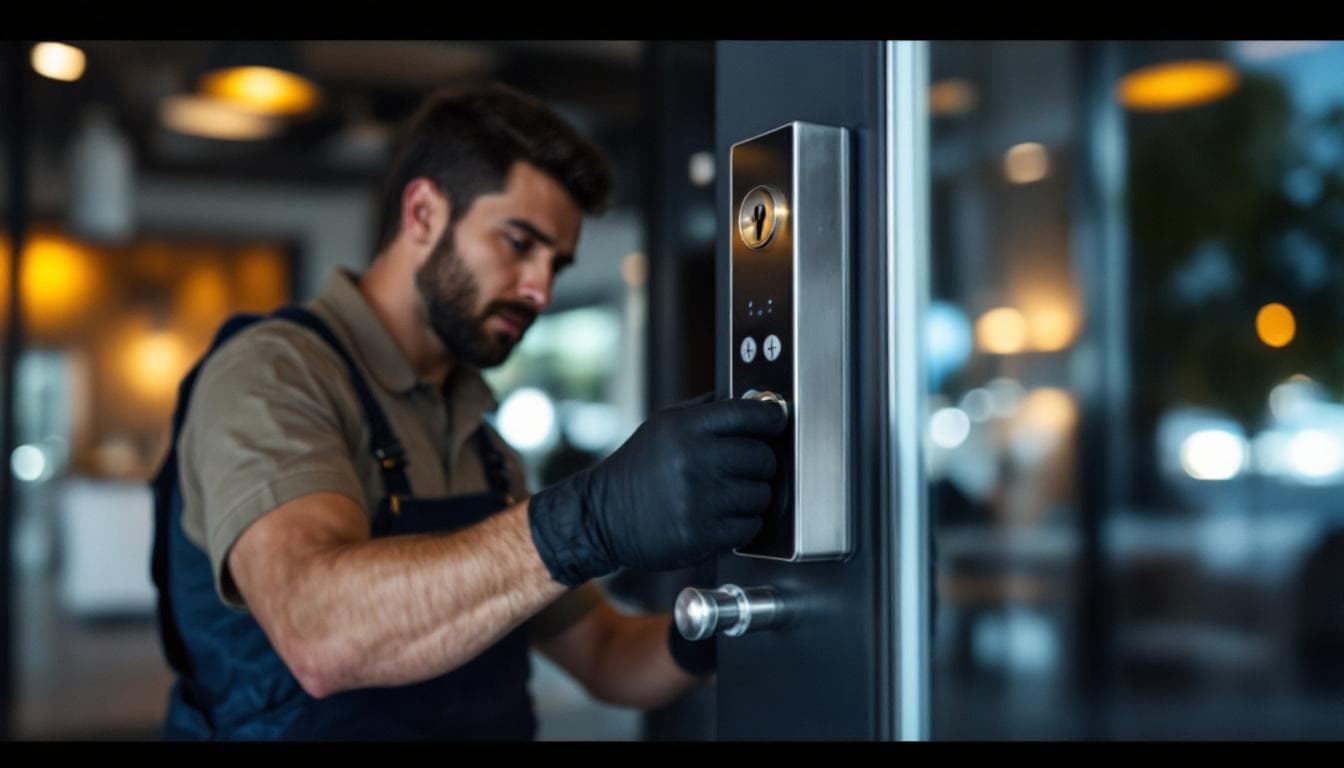
The Inland Empire is one of the fastest-growing commercial and logistics corridors in the United States. From the massive distribution center complexes along the 60 and 10 freeways to the retail strips of Rancho Cucamonga and Fontana, to the medical campuses of Loma Linda and Redlands — business owners throughout the region face lock and access security challenges that are categorically different from residential situations.
This guide covers the full spectrum of commercial locksmith services available in the Inland Empire, with practical guidance on when each service applies to your business.
Commercial Locksmith vs. Residential Locksmith: The Key Differences
Commercial lock work involves several layers of complexity that residential service does not:
Higher security requirements. Commercial locks are subject to more attempted breaches — shoplifting attempts, after-hours break-ins, disgruntled employee scenarios — and the cost of a breach is higher in both financial and liability terms.
Multi-user access management. A home typically has 2–5 key users. A business may have 5–150+ staff, contractors, vendors, and management with different access level requirements. Managing this at scale requires planned architecture, not ad hoc key distribution.
Regulatory compliance. Commercial facilities in California may have fire code requirements affecting specific lock types on egress doors. A locksmith performing commercial work must understand these requirements.
Business continuity. A homeowner locked out of their house is inconvenient. A business locked out during operating hours is losing revenue every minute. Response time matters more in commercial scenarios.
Master Key Systems: The Foundation of Commercial Access Management
A master key system is the standard solution for commercial facilities with multiple doors and multiple staff access tiers. Here is how it works.
In a master key system, each lock is keyed with a two-level cylinder: it responds to its own unique change key, AND it responds to a master key that opens every lock in the system.
A well-designed commercial master key system for an Inland Empire business might look like:
- Grandmaster key: Opens every door on the property — for ownership and building management
- Master key: Opens all doors in a specific zone (e.g., all back-office doors) — for department managers
- Change key (individual): Opens only one specific lock — for general staff assigned to a specific area
The system can be extended to "Great Grandmaster" keys for ownership across multiple locations, sub-master keys for sub-zones, and any combination of cross-keying arrangements the business requires.
Lock Busters designs and installs master key systems for retail stores, office complexes, medical offices, warehouses, auto service centers, and property management portfolios across the Inland Empire.
High-Security Commercial Locks: When Grade 1 Is Not Enough
Standard ANSI Grade 1 deadbolts are the right answer for residential applications. For commercial facilities with higher risk profiles — medical offices, cash-handling businesses, jewelry retailers, dispensaries, law offices with client-sensitive files — high-security commercial locks provide an additional tier of protection.
Characteristics of True High-Security Commercial Locks
Restricted key control. High-security keys cannot be duplicated at any hardware store or key kiosk. Duplicates can only be made by licensed dealers, creating a controlled key management chain.
Anti-drilling. Hardened steel inserts and spinning elements resist carbide drill bits — one of the most common forced-entry methods.
Anti-pick pins. Spool and serrated pins with extreme tolerance requirements make sport picking and bump key attacks effectively impractical without hours of effort.
Anti-impression resistance. The key profile makes taking wax impressions for unauthorized key cutting extremely difficult.
ANSI/BHMA Grade 1 minimum. All high-security commercial locks we recommend and install hold ANSI Grade 1 certification as a baseline.
Recommended High-Security Brands
- Medeco: Industry standard for high-security applications. Used in banks, government facilities, medical practices, and high-value retail throughout California.
- Mul-T-Lock: Israeli-designed multi-level security cylinders widely used in commercial applications. Strong anti-drill and restricted key duplication.
- ASSA Abloy: Global commercial security leader with product lines covering everything from basic Grade 1 to certified high-security cylinders.
- Schlage Commercial Series: More accessible price point with genuine Grade 1 commercial hardware quality. Excellent for office buildings and retail.
Electronic Access Control: The Modern Commercial Security Layer
For Inland Empire businesses managing larger teams, multiple entry points, or a need for detailed access logging, electronic access control systems provide capabilities that mechanical keys cannot:
Credential-based access: Cards, fobs, PIN codes, or smartphone credentials that can be individually activated or deactivated in seconds — critical for staff turnover scenarios.
Timed access schedules: A warehouse may allow floor staff access Monday–Friday 6am–6pm, with no access outside those hours. Time-restricted access eliminates the "after-hours forgotten key" problem entirely.
Access event logging: Every entry is recorded with a timestamp and the specific credential used. This is valuable for HR investigations, theft incidents, insurance claims, and compliance audits.
Remote management: Property managers can monitor and adjust access across multiple Inland Empire locations from a single software dashboard.
Lock Busters installs commercial access control systems ranging from single-door keypad access for small offices to multi-door card/fob systems for large commercial facilities.
Commercial Lockout Service
Business lockouts — a misplaced key, a lock malfunction, a terminated employee changing a code without authorization — require fast response. Every minute of disrupted access during business hours has a direct cost.
Lock Busters provides commercial lockout service across all Inland Empire cities. Our average commercial response time is 25–40 minutes. We carry commercial-grade pick, bypass, and decoder tools for the full range of commercial hardware configurations.
For common commercial door types:
- Standard commercial deadbolts and knob sets: 5–15 minutes
- Panic hardware (push bars, crash bars): Varies by model, typically 10–20 minutes
- Mortise locks: 10–25 minutes depending on condition
- Commercial padlocks: 2–10 minutes
What to Do When an Employee Leaves on Bad Terms
One of the most critical and time-sensitive commercial locksmith situations: a terminated employee, especially one who departed under adversarial circumstances, may have unauthorized key access to your facility.
Immediate actions after a contentious termination:
- Retrieve all issued keys before or during the termination meeting if possible
- Rekey all locks the individual had access to immediately — that same day
- Deactivate any electronic credentials (card, fob, PIN) immediately during the meeting
- Review and change security alarm codes if the employee had them
- Brief other employees on the situation to prevent social engineering attempts
Lock Busters provides same-day commercial rekeying service across the Inland Empire for exactly these situations. Call (909) 935-8844 for emergency commercial service.
What the Industry Data Says
Commercial-grade hardware is governed by ANSI/BHMA A156.2 (locks) and A156.13 (mortise locks), which set the durability, operational-cycle, and forced-entry standards that distinguish commercial-rated hardware from residential[^bhma-commercial]. The Door and Hardware Institute, the trade association for commercial door hardware, reports that properly specified Grade 1 commercial hardware has a service life of 800,000 to 1.5 million operational cycles, compared to roughly 200,000 cycles for builder-grade residential locks[^dhi-cycles]. The U.S. Small Business Administration's Office of Advocacy estimates that physical-security incidents (forced entry, internal theft, key control failures) cost U.S. small businesses approximately $50 billion annually, with most incidents traceable to under-specified hardware, lapsed key control, or both[^sba-security].
"The most expensive lock in commercial isn't the one you bought — it's the one you have to rip out and replace at year three because someone specified residential hardware on a 200-cycle-per-day door."
— Lloyd Seliber, master-keying specialist and commercial-hardware instructor
What to Do Right Now
If you're a small-business owner in the Inland Empire reviewing your physical security:
- Inventory every exterior and high-value-interior lock by grade. Anything Grade 3 or unrated on an exterior door is undersized for commercial use. Replace within 90 days.
- Document key holders and recover keys from any former employee, contractor, or vendor with access. If key control is broken, rekey or recore the affected cylinders.
- Call (909) 935-8844 for a commercial security audit. We service IE businesses across San Bernardino, Rialto, Fontana, Colton, and Rancho Cucamonga. CA License #LCO 7776.
Specific Commercial Service Categories Common in the IE
The Inland Empire's commercial mix runs from light industrial in Fontana and Rialto through retail and food service in Rancho Cucamonga, Redlands, and Highland through warehousing in San Bernardino and Colton. The services we see most often:
- Commercial rekey after employee turnover. A retail store, restaurant, or warehouse losing a manager or key-holder employee should rekey every cylinder that employee had access to within 7 days. Typical cost: $35 to $65 per cylinder.
- Master-key system design and installation. A multi-tenant office or a multi-suite warehouse benefits from a single master-key plan that lets management carry one key while individual tenants or departments carry restricted keys. Plan design: $200 to $500 one-time + per-lock rekey or replacement.
- High-security cylinder upgrades on cash-handling and inventory rooms. Medeco, Mul-T-Lock, ASSA, and Abloy cylinders prevent picking, bumping, and key duplication without authorization. Typical cost: $185 to $325 per door installed.
- Electronic access control on multi-employee doors. Key-fob, card, PIN, or mobile-credential access with audit logging. Typical cost: $400 to $1,200 per door for a basic system, more for cloud-managed multi-door platforms.
- Panic-hardware and exit-device service. Commercial buildings are governed by NFPA 80 fire-door standards and ADA accessibility requirements; panic hardware must function correctly on every required egress door. Service or replacement: $250 to $750 per device.
How NFPA and ADA Affect Commercial Lock Choices
Two compliance frameworks affect every commercial door in the Inland Empire:
- NFPA 80 (Standard for Fire Doors and Other Opening Protectives) specifies that fire-rated doors must have hardware that does not interfere with the fire rating. A commercial deadbolt installed on a fire-rated door must itself be fire-rated; otherwise the entire opening loses its certification.
- ADA accessibility requirements specify that operating hardware on accessible doors must be operable with a closed fist (lever handles, not knobs) and require no tight grasping or twisting of the wrist. Replacing a knob with a Grade 2 commercial lever is often a required upgrade as part of any ADA remediation project.
A licensed commercial locksmith should know both frameworks and should warn you when a planned hardware change would create a compliance issue. Ask before authorizing the work.
Sources
[^bhma-commercial]: Builders Hardware Manufacturers Association — ANSI/BHMA A156.2 and A156.13 commercial-lock standards, https://www.buildershardware.com/
[^dhi-cycles]: Door and Hardware Institute — commercial hardware specifications, https://www.dhi.org/
[^sba-security]: U.S. Small Business Administration Office of Advocacy — small-business economic data, https://advocacy.sba.gov/
Frequently Asked Questions
What is a master key system and does my business need one?
A master key system allows different keys to open different combinations of locks. A manager's master key may open every door in the facility, while a stockroom employee's key opens only specific rooms. Any business with multiple doors and multiple staff access levels benefits from a properly designed master key system.
What are high-security commercial locks?
High-security locks feature reinforced materials, anti-drill and anti-pick resistance, restricted key duplication (keys cannot be copied at hardware stores), and ANSI Grade 1 or higher certification. Common brands: Medeco, Mul-T-Lock, ASSA Abloy, and Schlage commercial series.
Can Lock Busters install commercial access control systems?
Yes. We install keypad, card/fob, and smartphone-based access control systems for commercial properties — from single-door retail access to multi-door warehouse systems.
What happens if an employee key is lost or an employee is terminated?
For traditional locks, rekeying the affected locks immediately is essential — particularly for terminated employees. For access control systems, deactivating the credential takes seconds. This is a key advantage of electronic access control over mechanical key systems.
Do you service commercial businesses after hours in the Inland Empire?
Yes. Lock Busters provides commercial locksmith service Monday–Friday 6am–7pm, Saturday 6am–7:30pm. For after-hours business emergencies, call (909) 935-8844 to discuss availability.