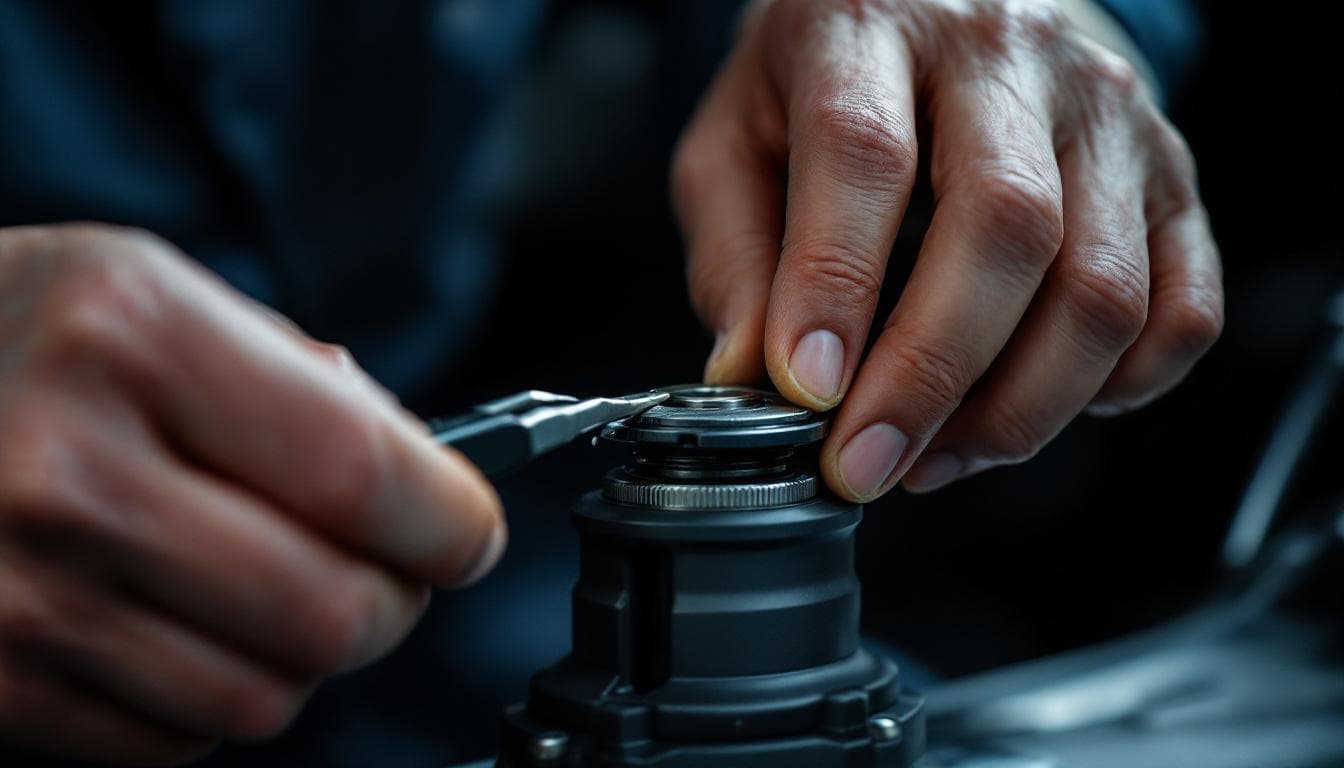
Ignition problems rarely arrive as a dramatic failure. They almost always begin subtly: the key feels a little stiffer than it used to, requires more pressure to turn, or occasionally sticks for a half-second before releasing. Most drivers live with these symptoms for weeks or months before the situation forces a resolution — either because the key breaks off inside the ignition, or because the cylinder fails entirely and the car will not start at all.
Understanding the progression helps you address it at the least expensive and least disruptive point.
The Four Stages of Ignition Wear
Stage 1 — Stiffening. The key requires slightly more force to turn. Often attributed to cold mornings or a "quirky" car. In reality: the ignition wafers and key blade are wearing against each other, beginning to lose their precision fit.
Stage 2 — Occasional sticking. The key occasionally requires multiple attempts or a specific entry angle to turn. The wafers are no longer moving smoothly in their channels. Debris, worn surfaces, and oxidation are accumulating.
Stage 3 — Key won't turn at all. The key inserts but will not rotate. This may happen suddenly — often after an extended period in the driveway when the steering column lock engaged at a slight angle. It may also indicate the wafers have worn to a point where they no longer properly align.
Stage 4 — Key breaks in ignition. A worn or fatigued key blade snaps under the increased torque required to operate a worn ignition cylinder, leaving a fragment lodged inside. The vehicle is now completely inoperable.
Why the Steering Wheel Lock Creates a Common "My Key Won't Turn" Scenario
Before calling a locksmith, attempt this first: if your key won't turn, try firmly turning the steering wheel left and right while simultaneously applying light rotational pressure to the key. In many cases, the steering column lock engaged at an angle and is binding the cylinder mechanically.
If the key begins to turn after this attempt, the cylinder is likely fine — the steering lock was the culprit. If it remains stuck regardless, proceed to calling Lock Busters.
What Broken Key Extraction Involves
Broken key extraction from an ignition is a standard procedure that does not require disassembly of the dash or steering column in most cases.
The process:
- Verify the exact break point — is the broken fragment at the cylinder face, partially inserted, or fully inside the cylinder?
- Select appropriate extraction tools — needle-nose hooks, wire extractors, or specialized key removal spirals depending on fragment depth and position
- Carefully maneuver the fragment to a position where it can be gripped and withdrawn
- Withdraw the fragment without spinning the cylinder, which would push the fragment deeper
Time: 10–30 minutes depending on fragment position and cylinder condition.
Cost at Lock Busters: $75–$125 for extraction only.
If the ignition cylinder was damaged during the key break or extraction, replacement may be necessary. We assess cylinder condition after extraction before recommending replacement.
What Ignition Cylinder Replacement Involves
When the cylinder is worn beyond smooth operation, or was damaged by a broken key, full replacement is the appropriate solution.
The replacement process:
- Remove the steering column shroud (plastic cover around the column) to access the ignition assembly
- Disconnect the ignition cylinder from the electrical connector and the mechanical linkage to the transmission lock
- Remove the existing cylinder using a release pin at the back of the housing
- Install the new cylinder, reconnect electrical and mechanical linkages, reassemble the shroud
- Cut a new key to the replacement cylinder's specification
- Program the new key to the vehicle's immobilizer via OBD-II (required on all post-1996 vehicles with transponder systems)
- Test: key turns smoothly in all positions (ACC, ON, START), engine starts normally, all ignition functions operate correctly
Total time: 60–120 minutes on-site at your location.
Lock Busters performs ignition replacement on-site in parking lots, driveways, and roadsides across the Inland Empire. No towing required.
Ignition Repair Costs: Lock Busters vs. Dealership
| Service | Lock Busters | IE Dealership |
|---|---|---|
| Broken key extraction | $75–$125 | $150–$250 |
| Ignition cylinder replacement (domestic) | $195–$280 | $350–$550 |
| Ignition cylinder replacement (import) | $240–$350 | $400–$650 |
| Key cutting + programming (included) | Included | Often separate charge |
All Lock Busters prices include cutting, programming, and labor. No towing. No shop fees.
Common Inland Empire Vehicles and Their Ignition Issues
Toyota Camry / Corolla (2002–2012): The most commonly serviced ignition in our area. After 100,000+ miles, the OEM wafer-style ignition cylinder wears noticeably. Key sticking is the standard presentation. Replacement cost: $195–$240.
Honda Civic / Accord (2001–2015): Honda's ignition cylinders develop a characteristic stiffness with age. The lock is particularly sensitive to worn key blade profiles. Replacement cost: $195–$250.
Ford F-150 (2004–2014): The F-150's ignition is exposed to significant vibration and use stress. Sticking and eventual failure are common after high mileage. Replacement cost: $220–$280.
Dodge Ram / Chrysler vehicles (2002–2012): The TIPM (Totally Integrated Power Module) in Chrysler products can create ignition symptoms that mimic cylinder failure but are actually electrical. We diagnose before recommending cylinder replacement.
GM vehicles (Chevy Silverado, GMC Sierra, 2003–2012): A known ignition switch recall issue affected millions of GM vehicles in this era. If your GM vehicle has not had the recall addressed, this should be confirmed before any ignition work.
When to Call Immediately vs. When You Have Time
Call immediately if:
- A key fragment is lodged in the ignition (the vehicle is inoperable)
- The key turns partially but the engine will not start
- The cylinder spins freely without resistance (a sign of significant internal failure)
- You are stranded at any location
You have a window (hours to days) if:
- The key is stiff but still turning
- You are experiencing intermittent sticking but the car starts reliably
- A spare key works better than the primary (indicating key wear, not cylinder wear)
In all cases, do not allow the situation to progress to a broken key. The extraction and cylinder damage costs significantly more than addressing early ignition wear.
Call (909) 935-8844) for ignition repair and extraction service across all Inland Empire cities.
What the Industry Data Says
Ignition lock cylinder failure is one of the most common non-collision automotive lock-and-key service calls. The National Highway Traffic Safety Administration's complaints database shows that ignition-related complaints are consistently among the top 10 non-safety component categories for vehicles older than 8 years[^nhtsa-complaints]. J.D. Power's 2024 U.S. Vehicle Dependability Study tracked "had to use key in unusual way to start vehicle" as a discrete reliability metric and noted measurable degradation in older vehicles, particularly in dust- and heat-exposed climates like the Inland Empire's[^jdpower-vds-2024]. The Automotive Service Association notes that ignition cylinder replacement on most pre-2010 vehicles can be performed by a credentialed mobile locksmith on-site, while post-2010 anti-theft systems often require coordinated cylinder-and-immobilizer reprogramming[^asa-tech].
"A worn ignition cylinder doesn't fail all at once. It fails in increments — a hard turn, a stuck moment, a half-second of jiggling — over months. By the time the customer calls us, they've usually been ignoring it for six months and finally got stranded."
— Cliff Cline, automotive locksmith and longtime contributor, Locksmith Ledger International
What to Do Right Now
- Stop using force on a sticky ignition. Every hard turn accelerates internal wear and increases the probability of a broken key inside the cylinder — a much more expensive repair.
- Have the cylinder inspected within 30 days of the first symptom. A worn cylinder replaced on schedule runs $185 to $285. A failed cylinder with a broken key extraction runs $260 to $475.
- Call (909) 935-8844 for on-site ignition diagnosis and replacement. Same-day service across the Inland Empire. CA License #LCO 7776.
Common Vehicle Models and Symptoms in the Inland Empire
Some vehicle-and-year combinations show up far more often than others for ignition-cylinder work in the IE:
- 2005–2012 Toyota Tacoma, Tundra, 4Runner. High-mileage work trucks operating in dusty environments wear the ignition cylinder faster than the manufacturer expected. Symptoms: key has to be "wiggled" to turn, occasional moments where the key turns but the dash lights don't come on, increasing difficulty over months.
- 2008–2014 Chevrolet Silverado, GMC Sierra, Tahoe, Yukon. GM had a well-documented ignition-cylinder issue across this generation; many vehicles have already been recalled or repaired but late-model purchases by IE owners sometimes inherit the original cylinder.
- 2007–2012 Ford F-150 and F-250. The PATS-era ignition cylinder on these trucks wears predictably, with the symptom set matching the Toyota truck pattern above.
- 2005–2010 Dodge Ram and Jeep Grand Cherokee. Cylinder wear is common; symptoms typically present as a "stuck" key on cold mornings before progressing to constant difficulty.
- 2009–2015 Honda Civic and Accord. Less common than the truck list above but still a regular service call, typically in vehicles that have crossed 150,000 miles.
If your vehicle is on this list and you have noticed any of the symptoms — key jiggling, intermittent no-start despite a turning key, increasing difficulty over weeks — schedule an inspection before the cylinder fails completely. A replaced-on-schedule cylinder is a $185 to $285 job. A failed cylinder with a broken key extraction or a no-start that requires a tow runs $260 to $475.
Why Inland Empire Climate Accelerates Cylinder Wear
San Bernardino County's climate creates conditions that accelerate ignition-cylinder wear faster than most California regions:
- Summer heat. Cabin temperatures of 130°F+ in unshaded parking expose the cylinder's internal springs and pins to thermal stress beyond what the cylinder was designed for.
- Dust and fine particulate. The high-desert environment in the IE (Lytle Creek, Cajon Pass, areas east of I-15) introduces fine grit into the cylinder through the key-bow, where it grinds the wafers and pins on every key turn.
- Long commutes. IE drivers average 18 to 22 percent more vehicle-miles per year than the LA County average, meaning more key-turns per calendar year on the same cylinder.
The combination explains why a Toyota Tacoma in San Bernardino sees ignition-cylinder failure at 130,000 miles when the same vehicle in coastal San Diego might run to 200,000 miles before any symptom appears.
Sources
[^nhtsa-complaints]: National Highway Traffic Safety Administration — Vehicle Complaints database, https://www.nhtsa.gov/recalls
[^jdpower-vds-2024]: J.D. Power 2024 U.S. Vehicle Dependability Study, https://www.jdpower.com/business/press-releases/2024-us-vehicle-dependability-study
[^asa-tech]: Automotive Service Association — technical resources, https://asashop.org/
Frequently Asked Questions
Why is my car key suddenly hard to turn in the ignition?
The most common causes are: worn key blade or worn ignition wafers (they wear against each other over time), a steering wheel lock engaged at an angle causing resistance, a binding ignition cylinder due to debris or wear, or a worn key that can no longer properly align the wafers.
Can a locksmith extract a broken key from the ignition?
Yes. Broken key extraction from the ignition is a standard locksmith service. We use specialized extraction hooks and picks to remove the broken piece without damaging the ignition cylinder. The process usually takes 10–25 minutes.
How much does ignition cylinder replacement cost in the Inland Empire?
Ignition cylinder replacement at Lock Busters costs $195–$350 depending on vehicle make, model, and year. The replacement includes a new cylinder, key cutting, and programming if the vehicle requires a transponder. Dealerships charge $350–$600 for the same service.
Can I drive with a damaged ignition?
Possibly for a short time, but a damaged ignition is a risk — it can fail completely at any time, leaving you stranded. It can also cause unintended engine shutoff while driving if the cylinder slips. Address ignition issues immediately.
Does ignition replacement require programming?
On most post-1996 vehicles, yes. The new ignition cylinder must be programmed to communicate with the vehicle's immobilizer system. Lock Busters handles this on-site as part of the ignition replacement service.