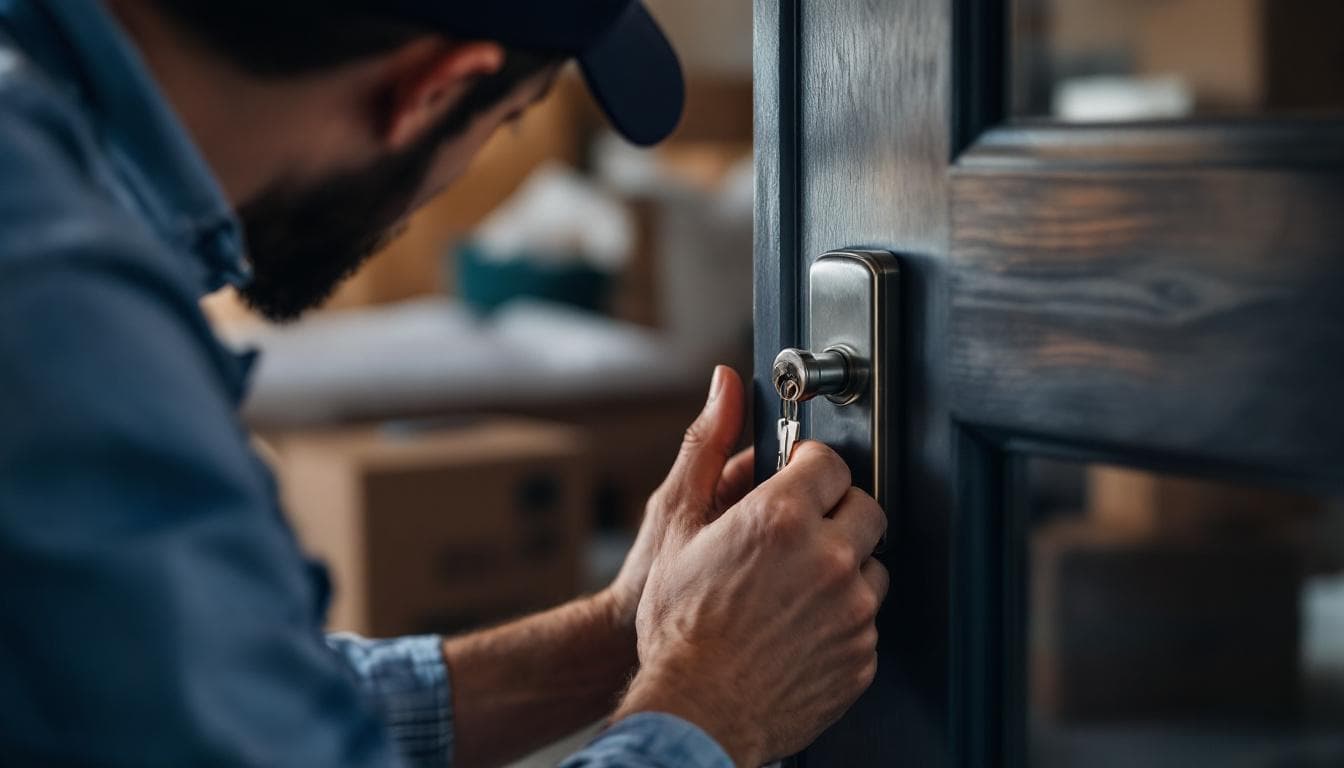
Moving into a new home is one of the most significant days of your life. It is also, without exaggeration, a day when your home is at its most vulnerable from a security standpoint.
Here is the reality that most new homeowners in the Inland Empire do not consider until it is too late: at the moment you receive your keys at closing, you have no verifiable knowledge of how many copies of those keys exist in the world.
Who Might Have Keys to Your New Home Right Now
When you close on a resale property, consider who has interacted with that property over the past decade or more:
- The previous owners and every member of their household
- Copies made for adult children, elderly parents, neighbors with emergency access
- Any housekeepers or domestic workers who were given keys
- Contractors who performed repairs — plumbers, HVAC technicians, roofers, electricians
- Real estate agents (the listing agent, buyer's agent, and potentially multiple showing agents)
- Property management companies if the home was ever a rental
- Previous tenants if there was ever a tenancy
- Any copies made for those tenants' household members
A realistic estimate for a resale home with a typical ownership and rental history: 5–15 unknown key copies potentially in circulation.
New Construction Is Not Exempt
Many Inland Empire buyers assume new construction is safe from this problem. It is not.
During construction, your builder uses a construction master key — a single key that opens every lock on every home under construction in the development. This key is used by general contractors, subcontractors, building inspectors, and any other party who needs access during the build.
When you move in, every lock in your home still responds to that construction master key. Until you rekey, anyone who ever had a copy of the builder's construction master key can unlock your front door.
A single call to Lock Busters before you start unpacking resolves this entirely.
Rekey vs. Full Lock Replacement: How to Choose
Rekeying is right when:
- The existing locks are in good working condition mechanically
- You are satisfied with the security grade of the hardware (Grade 1 or Grade 2 deadbolts)
- You want to save money — rekeying is significantly cheaper than replacement
- You want all locks rekeyed to a single key for convenience
Rekeying changes the internal pin configuration of the lock cylinder. The key you received at closing no longer works. New keys are cut to a new pattern. The entire process takes about 20 minutes per lock.
Full lock replacement is right when:
- The existing hardware is worn, damaged, or low-grade security
- You want to upgrade to Grade 1 deadbolts from currently installed Grade 2 or lower hardware
- You want to add smart lock functionality
- The locks show signs of previous tampering or attempted picking
- You simply want the psychological clean-break certainty of all-new hardware
What a Full Home Rekey Costs in the Inland Empire
Lock Busters pricing for residential rekeying:
| Service | Cost |
|---|---|
| Service call fee | $55–$75 |
| Per-lock rekeying | $25–$45 per lock |
| Typical 3BR home (5–6 locks) | $200–$345 total |
| Typical 4BR home (7–8 locks) | $265–$435 total |
| Same-key convenience (all locks to one key) | Included |
We rekey all locks to a single master key as standard — no charge. No more hunting through a keyring for the right key for each door.
The Full Move-In Security Checklist
Rekeying is the foundation, but a complete move-in security review covers more:
1. Rekey or replace all exterior door locks (front, back, side, patio/slider lock).
2. Reset garage door keypads and change the garage door opener code. If your garage connects to the home's interior, it is effectively another exterior entry point.
3. Check all sliding door and window locks. These are frequently the path of least resistance in older IE homes. We can assess and upgrade secondary entry point hardware during the same appointment.
4. Evaluate door frame and strike plate quality. The most common residential break-in method in the Inland Empire is not lock picking — it is kicking the door frame until the strike plate fails. A Grade 1 strike plate with 3-inch screws into the wall stud dramatically increases resistance.
5. Check for hidden spare key locations. The previous occupant may have left keys hidden outside. Check standard locations: under the doormat, above the door frame, under potted plants, inside fake rocks, in the garage.
6. Update smart lock codes and app access if the home has existing smart lock hardware. Full removal and replacement of smart lock is recommended if you cannot verify the previous owner's account was fully deprovisioned from the lock's app.
Serving New Homeowners Across the Inland Empire
Lock Busters serves new homeowners across our 10-city service area — San Bernardino, Rialto, Fontana, Highland, Redlands, Colton, Grand Terrace, Loma Linda, Muscoy, and Rancho Cucamonga.
We typically complete a full home rekey in a single appointment lasting 45–90 minutes. Same-day service is available in most of our coverage area.
Call (909) 935-8844 for a free phone quote. Mention you are a new homeowner — we will walk through the full security checklist with you.
What the Industry Data Says
The case for rekeying after a move is well established in the security-research literature. The FBI's Crime Data Explorer reports that residential burglary remains one of the most common property crimes nationally, with the majority of forced entries occurring through doors rather than windows[^fbi-burglary]. The Insurance Information Institute notes that most homeowner's insurance carriers consider key control a "reasonable precaution" requirement, meaning a claim arising from a burglary by someone with a prior copy of your key may be evaluated differently than a forced-entry claim[^iii-home]. ALOA Security Professionals Association recommends rekeying within the first 30 days of any home purchase or change of occupancy, citing the open question of how many copies of the existing keys are in circulation among prior owners, contractors, real-estate agents, neighbors, and former tenants[^aloa-rekey].
"When you buy a home, you have no idea how many keys exist for your locks. The seller knows of three. The reality is often eight or ten — contractors, neighbors, the agent's lockbox key, the cleaning service. Rekeying within the first week is the single highest-value security move a new owner can make."
— Clyde Roberson, CML, Master Locksmith and longtime industry educator
Rekey vs Replace — When Each Actually Makes Sense
Both options give you exclusive key control. The choice comes down to lock condition and budget:
- Rekey is right when your existing locks are in good mechanical condition (Grade 1 or Grade 2 BHMA, no visible damage, smooth operation) and the cylinder type is rekeyable (most pin-tumbler residential locks). Cost: typically $20 to $40 per lock plus a service-call fee.
- Replace is right when your existing locks are builder-grade Grade 3, visibly worn, damaged, or part of a system you want to upgrade (e.g., moving from a single-cylinder to a double-cylinder deadbolt, or adding a smart lock). Cost: $80 to $250 per lock installed depending on grade and brand.
For most Inland Empire single-family homes with 3 to 6 exterior locks, a full-home rekey runs $120 to $260, while full replacement with Grade 2 hardware runs $400 to $1,200.
What to Do Right Now
- Schedule a rekey within the first 30 days of move-in. The cost is a fraction of replacement, the security benefit is identical for the cylinder change.
- Inventory every exterior lock before the call. Front door, back door, side gate, garage entry door, pool gate — count them all so the locksmith can give you an accurate quote.
- Call (909) 935-8844 for a same-day rekey appointment. We rekey on-site across San Bernardino, Rialto, Fontana, Highland, Redlands, Colton, and surrounding cities. CA License #LCO 7776.
What the Real Cost Difference Looks Like for an IE Single-Family Home
A typical Inland Empire single-family home in San Bernardino, Rialto, Fontana, Redlands, Colton, Highland, or Rancho Cucamonga has between 3 and 6 exterior locks: a front door, a back door, a side-yard gate, a garage entry door, and sometimes a pool gate or a side patio door. Pricing comparison for the full set:
- Rekey of 4 existing Grade 2 or Grade 3 deadbolts: $120 to $200 service call + $20 to $40 per cylinder = $200 to $360 total, completed on-site in 60 to 90 minutes.
- Replacement with Grade 2 mechanical deadbolts (Schlage B60, Kwikset 980, etc.): $80 to $140 per lock installed = $320 to $560 total, completed on-site in 90 to 150 minutes.
- Replacement with Grade 1 high-security or smart deadbolts (Medeco Maxum, Schlage Encode, Yale Assure Lock 2): $185 to $325 per lock installed = $740 to $1,300 total, completed on-site in 2 to 3 hours.
The right answer is almost always determined by the condition of the existing hardware. If the seller's locks are 5+ years old, Grade 2 or better, and operate smoothly with no key sticking or bolt drag, rekey is the high-value path. If the locks are obviously builder-grade Grade 3, visibly worn, or part of a system you want to upgrade for other reasons, replacement makes more sense in a single service call rather than two.
The First-Week Move-In Security Checklist
For any new home in San Bernardino, Rialto, Fontana, Highland, Redlands, Colton, Grand Terrace, Loma Linda, or Rancho Cucamonga:
- Day 1-2: Inventory every exterior and high-value-interior lock. Front door, back door, side gate, garage entry door from the garage into the house, pool gate, basement door if applicable. Count cylinders, not doors.
- Day 2-3: Schedule rekey or replacement. Most IE locksmiths can dispatch same-day or next-day for a planned (non-emergency) appointment.
- Day 3-5: Test smart-home integrations. If the home included smart locks, smart garage openers, or a smart-home hub, re-pair everything to your account and revoke the seller's access.
- Day 7: Confirm spare-key distribution. Two physical spares minimum — one with you, one with a trusted family member off-property. Never leave a spare under a doormat, in a planter, or on top of a doorframe.
- Day 14: Audit garage and exterior storage. Garden sheds, detached garages, and pool equipment rooms often have separate keys that came with the home — rekey or replace those too.
Sources
[^fbi-burglary]: FBI Crime Data Explorer — Burglary statistics, https://cde.ucr.cjis.gov/
[^iii-home]: Insurance Information Institute — Homeowners insurance overview, https://www.iii.org/article/homeowners-insurance
[^aloa-rekey]: Associated Locksmiths of America — residential security guidance, https://www.aloa.org/
Frequently Asked Questions
Why should I rekey after moving into a home?
When you receive keys at closing, you have no way of knowing how many copies exist or who holds them. Previous owners, former tenants, contractors, housekeepers, real estate agents, and neighbors may all have copies. Rekeying immediately eliminates that unknown.
What is the difference between rekeying and replacing a lock?
Rekeying changes the internal pin configuration so the existing key no longer works — new keys are cut to a new pattern. The lock hardware stays. Lock replacement swaps the entire hardware assembly. Rekeying is faster and less expensive when the hardware is in good condition.
How much does rekeying a home cost in the Inland Empire?
Lock Busters charges $25–$45 per lock for rekeying, with a service call fee of $55–$75. A typical 3-bedroom home with 5–6 locks rekeyed to a single key runs $200–$350 total.
Should I also change the garage door code?
Yes. The garage door code and any keypads should be reset immediately when you move in. If the garage connects to the interior of the home, it is as important as the front door lock.
Does a new construction home need rekeying?
Yes. During construction, multiple contractors use a universal "construction master key" for access. All new construction locks should be rekeyed before or immediately after move-in to ensure contractor keys no longer work.