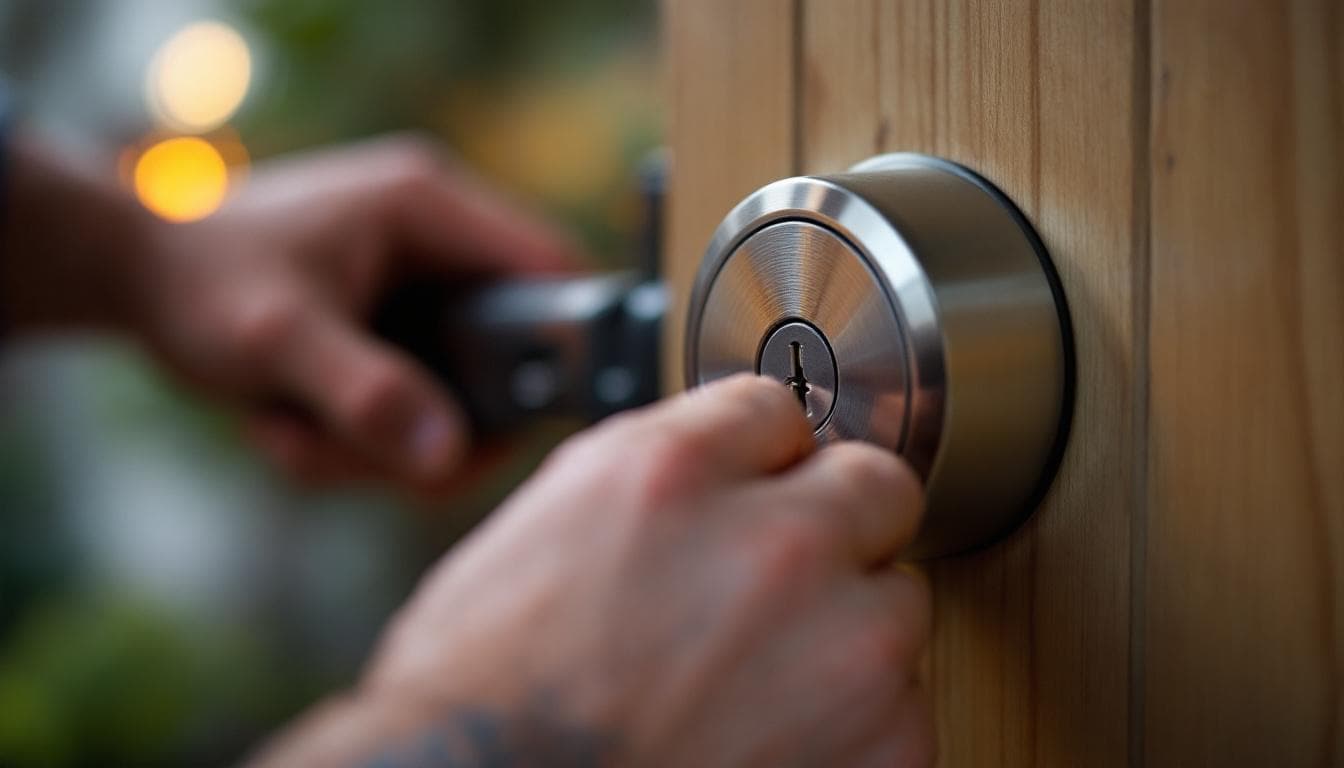
High-security locks are the most common upgrade we recommend to clients who have just experienced a break-in attempt or who have recently researched residential security. They are also the most common upgrade that, after full explanation, clients decide they do not need.
Both outcomes are correct. This guide helps you determine which applies to your situation.
What "High Security" Actually Means
The term "high security" is used loosely in marketing. For our purposes, a lock is genuinely high security if it meets all three of these criteria:
1. ANSI Grade 1 physical strength. The bolt, housing, and strike hardware resist physical attack — kicking, hammer strikes, pry tools. This is the same standard used by standard Grade 1 deadbolts, so it is the baseline, not the differentiator.
2. Advanced cylinder security. Anti-pick design using spool or serrated pins (significantly more resistant to manipulation than standard pins). Anti-drill inserts in the cylinder face. Anti-bump resistance through tight manufacturing tolerances and sidebar or rotating elements that defeat bump key attacks.
3. Restricted key duplication. Keys for high-security locks cannot be duplicated at a hardware store, key kiosk, or by a locksmith without factory authorization. Copies require documentation, authorization codes, and are only available through licensed dealers. This is the element that makes high-security locks genuinely different from Grade 1 locks, not just physically stronger.
The Three Leading High-Security Brands
Medeco
Medeco has been the benchmark American high-security lock for decades. Used in medical facilities, government buildings, law firms, financial institutions, and high-value residential applications. The Medeco design uses three-axis key cuts (the standard two cuts plus a rotational angle) that require precise alignment across three dimensions for operation. This makes picking, bumping, and impressioning attacks extremely difficult.
Medeco key duplication requires factory-issued authorization documentation. Keys can only be cut by authorized Medeco dealers.
Residential deadbolt installed cost: $235–$340
Mul-T-Lock
An Israeli-developed multi-level security cylinder used extensively by government and military installations. The Mul-T-Lock design combines a conventional pin-tumbler with an internal disc tumbler — two independent security mechanisms that must both be satisfied simultaneously. This makes picking attacks require defeating two completely different mechanisms at the same time.
The MT5+ series includes a spring-loaded sidebar that resists bump key attacks and adds a third security element.
Residential deadbolt installed cost: $215–$310
ASSA Abloy / Sargent & Greenleaf
The global commercial security leader. ASSA Abloy's residential high-security products include the ASSA MAX and ASSA CLIQ lines. More commonly used in commercial applications but available for residential. Key duplication through an authorization program similar to Medeco.
Residential deadbolt installed cost: $195–$285
The Realistic Threat Assessment: Who Actually Needs High-Security Locks?
This is where the honest conversation happens.
The most common residential break-in method in the Inland Empire — as in most of California — is not lock picking. It is:
- Kicking the door frame until the strike plate fails (most common — 60–70% of residential break-ins)
- Breaking a window — glass pane adjacent to the lock, a nearby slider, or a garage window
- Unlocked entry points — side gates, back windows, or doors the residents genuinely forgot to lock
Against these three most common attack methods, a high-security lock provides zero additional protection over a properly installed Grade 1 deadbolt with an extended strike plate. The attacker is not engaging the lock at all — they are bypassing it.
High-security locks provide meaningful additional protection specifically against:
- Lock picking (defeated by high-security anti-pick features)
- Bump key attacks (defeated by high-security anti-bump features)
- Key duplication by unauthorized parties (defeated by restricted key control)
These attack vectors are more common in targeted attacks than opportunistic ones — scenarios where someone has specific motivation to access your property and time to plan their approach.
The Profiles That Benefit Most from High-Security Locks
High-value residential properties. Homes in higher-value IE neighborhoods — specific areas of Rancho Cucamonga, Redlands, and Highland — where the contents justify a more sophisticated security investment.
Home-based medical, legal, or financial professionals. Client records and materials with regulatory confidentiality requirements justify physical security measures beyond the residential norm.
Homeowners with specific key-control requirements. If you have had keys in circulation among contractors, previous tenants, or staff and want verifiable key control going forward, restricted key duplication is uniquely valuable.
Rental property owners with high-value units. Controlling unauthorized key duplication between tenancies is a specific use case where restricted key duplication has direct value.
Homeowners who have experienced a prior break-in or attempt. The psychological value of the upgrade is real — and a targeted attacker who previously surveyed your property will recognize upgraded hardware as an increased risk factor.
For Most Inland Empire Homeowners: The Better Investment
If your primary concern is realistic residential security — protecting against opportunistic burglary — the highest-return security investment is:
- Schlage B60N Grade 1 deadbolt with extended Grade 1 strike plate using 3-inch screws (your current locks upgraded)
- Door frame reinforcement — steel door frame reinforcement plate around the strike area
- Exterior lighting — motion-activated lights at all exterior entry points
- Visible alarm system presence — monitoring yard sign and window stickers
This combination addresses the three most common break-in vectors at a total cost of $300–$600, compared to $700–$1,200 for a full high-security lock upgrade that addresses only two of the three.
If after considering this framework you have specific key-control or anti-manipulation requirements — we install Medeco and Mul-T-Lock across all Inland Empire cities. Call (909) 935-8844 for an honest assessment and installation quote.
What the Industry Data Says
High-security locks are defined by ANSI/BHMA A156.30, the standard that specifies the destructive-attack and key-control requirements that distinguish a high-security cylinder from a standard residential or commercial lock[^bhma-a156-30]. The FBI's Crime Data Explorer shows that residential burglary remains a major property crime, with the majority of forced entries occurring through doors — the failure point most directly addressed by a high-security cylinder upgrade[^fbi-burglary]. Underwriters Laboratories operates a separate UL 437 listing for high-security locks that adds attack-resistance testing beyond the BHMA framework[^ul-437]. Medeco, Mul-T-Lock, ASSA, and Abloy are the primary brands holding both BHMA A156.30 Grade 1 and UL 437 listings.
"The high-security cylinder is the lock upgrade with the largest gap between perceived and actual benefit. Most homeowners don't realize that a standard residential pin-tumbler cylinder can be picked or bumped open in under 60 seconds by a moderately skilled attacker. A genuine high-security cylinder simply doesn't yield to those techniques."
— Clyde Roberson, CML, Master Locksmith and longtime industry educator (former Director of Technical Services, Medeco Security Locks)
What to Do Right Now
- Identify which doors warrant the upgrade. Front door, back door, garage entry door, side-yard gate — anywhere a determined intruder might focus.
- Check current locks for BHMA grade and UL listing. Anything ungraded or rated below Grade 1 on a high-risk door is a candidate for upgrade.
- Call (909) 935-8844 for a high-security lock consultation. We install Medeco, Mul-T-Lock, and ASSA across the Inland Empire. CA License #LCO 7776.
Specific Brands and Models Worth Considering
The high-security cylinder market is dominated by a small number of brands with genuine ANSI/BHMA A156.30 and UL 437 listings. The options most relevant to IE homeowners and small businesses:
- Medeco Maxum. The benchmark Grade 1 / UL 437 cylinder for residential and light-commercial use. Patented key control prevents unauthorized key duplication. $185 to $285 per cylinder installed.
- Mul-T-Lock MT5+. Multi-pin design with patented key blank; very high resistance to picking and bumping. $215 to $315 per cylinder installed.
- ASSA V-10. Swedish-origin high-security cylinder with rotating-pin design. $235 to $335 per cylinder installed.
- Abloy Protec2. Finnish-origin disc-detainer design — physically different from pin-tumbler in a way that defeats most picking and bumping techniques entirely. $285 to $385 per cylinder installed.
- BiLock Original. Sidebar-design high-security cylinder with patented key control. $245 to $345 per cylinder installed.
All of the above are dramatically more resistant to picking, bumping, and unauthorized key duplication than a standard residential pin-tumbler cylinder.
Patented Key Control — The Feature That Matters Most
Beyond physical attack resistance, the highest-value feature of a true high-security cylinder is patented key control. A genuine high-security key blank cannot be duplicated at a hardware store, a corner key kiosk, or even most general locksmith shops — duplication requires the original locksmith's authorization (typically a signed key card from the original purchase) and access to factory-controlled key blanks.
The practical benefit is straightforward: every key in circulation for your locks is one you authorized. A former tenant, a former employee, a former housekeeper, or a former contractor cannot make an unauthorized copy and hand it to someone else. For commercial applications and high-value residential applications, this single feature usually justifies the cost of the upgrade more than the picking and bumping resistance does.
Where the Upgrade Genuinely Pays Off vs Where It's Overkill
High-security cylinders are the right answer for specific situations:
- Front and back doors of a single-family home with high-value contents. Cash, jewelry, firearms, business inventory stored at the residence.
- Cash room, inventory room, server closet of a small business. Restricting access to the few people who need it.
- Multi-tenant rental property where the landlord wants assurance that former tenants cannot retain working keys.
- Vacation home that sits empty for weeks at a time and may be known to be empty by service providers, neighbors, or contractors.
High-security cylinders are overkill (and a poor return on investment) for low-risk applications: interior doors, garden sheds, pool equipment rooms, and detached garages with low-value contents.
Sources
[^bhma-a156-30]: Builders Hardware Manufacturers Association — ANSI/BHMA A156.30 high-security cylinder standard, https://www.buildershardware.com/
[^fbi-burglary]: FBI Crime Data Explorer — Burglary statistics, https://cde.ucr.cjis.gov/
[^ul-437]: Underwriters Laboratories — UL 437 high-security lock standard, https://www.ul.com/
Frequently Asked Questions
What makes a lock "high security"?
High-security locks combine three elements: ANSI Grade 1 physical bolt and housing strength, advanced cylinder design with anti-pick/anti-drill/anti-bump resistance, and restricted key control — keys that cannot be duplicated without factory authorization.
Are high-security locks worth the extra cost for a typical home?
For most typical Inland Empire homes, a well-installed Grade 1 deadbolt with a proper strike plate provides adequate security against the realistic threat profile. High-security locks are most valuable for high-value homes, home offices with sensitive materials, medical professionals, and homeowners with specific key-control requirements.
Can high-security locks be picked?
All mechanical locks can theoretically be defeated — the question is how long it takes and how much skill is required. A Medeco lock takes a highly skilled lockpicker 30–120+ minutes to manipulate. A standard Grade 1 takes 2–10 minutes. The deterrence value is significant.
Do high-security locks prevent bump keys?
Yes. Bump keys are effective against standard pin-tumbler designs. High-security locks use spool pins, serrated pins, rotating elements, and sidebar mechanisms that make bump attacks ineffective.
Where should I install high-security locks in my home?
Primary entry points — front door and any door connecting the garage to the home interior — are the highest-value locations for high-security locks. Secondary entries (back door, side door) can use standard Grade 1 with proper strike plates.