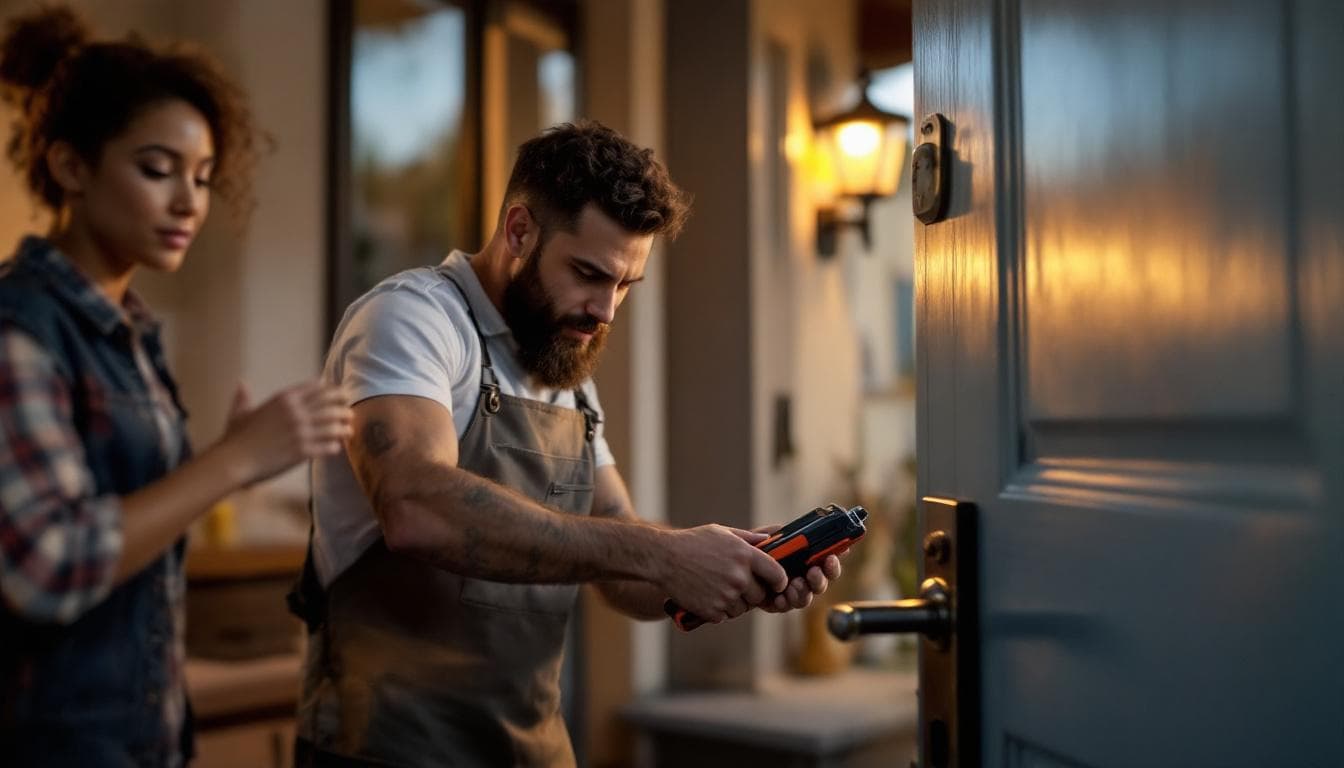
Home lockouts happen every single day across the Inland Empire — and they always seem to happen at the worst possible time. After a long shift at the distribution center in Fontana. Late at night in a residential neighborhood in Redlands. Early morning in San Bernardino before the kids need to get to school.
Regardless of when it happens, the resolution follows the same sequence. Here is exactly what to do.
Step 1: Check Every Entry Point Before Calling Anyone
This takes two minutes and resolves a meaningful percentage of apparent home lockouts:
Try all exterior doors. Front, back, side door, garage entrance — try them all. It is common to automatically assume the front door being locked means all doors are locked.
Try all accessible windows. Ground-floor windows that were left unlocked or slightly ajar are an obvious no-cost entry solution. This is also a reminder that unlocked ground-floor windows are a security concern worth addressing after you get inside.
Check for a hidden spare. If you or a previous occupant left a spare key outside — under a mat, above a door frame, under a flower pot, inside a fake rock — now is the time to find it.
Call someone with a spare. Family member, trusted neighbor, property manager — does anyone have a key to your home? A 15-minute wait for someone with a spare is always the lowest-cost outcome.
Step 2: Do Not Attempt to Force the Door
The impulse to push harder on a door that will not open, or to attempt credit card shimming, is understandable — and reliably expensive.
Forcing a door can damage the door frame, the strike plate, the door itself, and the lock mechanism. Frame repair runs $150–$600 depending on damage. Door replacement can exceed $1,000. These costs exceed any locksmith call many times over.
Credit card shimming only works on spring latches — the angled bolt on a doorknob that retracts when you push. It does not work on deadbolts. For any door with a deadbolt engaged, the card technique achieves nothing except minor scratching of the door frame.
Removing door hinges only works when hinges are on the exterior (unusual for modern residential exterior doors, which have hinges on the interior for exactly this security reason).
Wait for a professional. The time cost is 25–40 minutes. The financial cost of professional entry is $65–$95. The potential cost of forced entry damage is 3–10x that amount.
Step 3: Call Lock Busters
Call (909) 935-8844. Our dispatcher will ask:
- Your exact address
- What type of lock is on the door (standard deadbolt, electronic keypad, knob lock)
- Whether you have a lease or ownership document available (for identity verification)
- Whether there is any urgency (small children alone inside, gas smell, medical concern)
We provide an estimated arrival time and a confirmed price before dispatch.
What Happens When We Arrive
Identity verification. We verify you are a resident of the property. For homeowners: driver's license matching the address. For renters: driver's license plus lease agreement or utility bill. We cannot open a residential door without this verification — it is a critical security safeguard protecting you as a resident.
Lock assessment. We identify the lock type(s) on the door and confirm the appropriate non-destructive entry approach.
Door opening. For standard residential deadbolts and knob locks, we use pick tools calibrated to the specific lock profile. For most common Grade 1 and Grade 2 deadbolts — Schlage, Kwikset, Defiant, Brinks — the process takes 3–8 minutes.
For electronic keypad locks with a mechanical backup, we use the physical key override rather than attempting electronic bypass. For fully electronic smart locks with no physical override (rare but present), electronic bypass techniques may be needed.
Verification that all is well. We confirm the lock and door are functioning normally after entry.
Common Residential Lockout Scenarios in the Inland Empire
The "I didn't realize the door auto-locked" scenario. Many modern residential door handles have an auto-lock feature activated. Stepping outside for 30 seconds without your keys locks you out. This accounts for a large percentage of evening and weekend lockout calls.
The moving-day lockout. During move-in, the door locks behind you on a trip to the moving truck. Particularly common in apartment complexes in Fontana, Rialto, and San Bernardino where security doors are standard.
The key-left-inside-when-leaving scenario. The household keeps a key on a hook by the door. On the way out, the primary key was grabbed but the one on the hook remained. Standard exit — door locks. Key is inside.
The broken key in lock scenario. A worn key blade breaks in the deadbolt cylinder during a routine entry attempt. This requires broken key extraction plus lock assessment before entry is possible.
What a Home Lockout Costs — Transparent Pricing
- Standard residential lockout: $65–$95
- High-security or specialty lock: $85–$125
- Broken key extraction (additional to lockout): +$35–$65
After a lockout: if there was no spare key previously stored — make one immediately. Lock Busters can cut a spare key at the same appointment for your existing lock. Same-visit spare key: $25–$55 depending on key type.
Call (909) 935-8844 for immediate home lockout service across our 10-city service area.
What the Industry Data Says
Residential lockouts are the second most common reason homeowners call a locksmith, after key duplication and rekey work. ALOA's industry surveys put residential lockout volume at roughly 25 to 30 percent of typical mobile-locksmith call volume nationally[^aloa-survey]. The FBI's Crime Data Explorer continues to document residential burglary as a major property crime, with the majority of forced entries occurring through doors — a reminder that "I'll just kick it in" is both an injury risk and a real source of door-frame damage that costs more to repair than the locksmith service itself[^fbi-burglary]. The Insurance Information Institute notes that most homeowner's policies cover lockout-related door or lock damage under standard dwelling coverage, but specific deductibles and exclusions vary by carrier[^iii-home].
"The cheapest part of a residential lockout is the locksmith. The expensive part is the door frame you splintered trying to kick it in, the side-light glass you broke, or the deadbolt you destroyed prying it with a screwdriver. Call first, force second."
— Bret Schwartz, contributing writer, Locksmith Ledger International
What to Do Right Now
- Don't force entry on your own door. Door-frame and trim repair runs $300 to $1,200; a non-destructive lockout service runs $85 to $135.
- Verify the locksmith's California license before authorizing service. Check search.dca.ca.gov — Lock Busters is CA License #LCO 7776.
- Call (909) 935-8844 for non-destructive residential lockout service. 25- to 45-minute response across the Inland Empire.
What a Real Residential Lockout Service Looks Like
A non-destructive residential lockout by a credentialed mobile locksmith follows a defined sequence:
- Dispatch and ETA confirmation. You call (909) 935-8844 with your address and the lockout situation. We confirm a 25-to-45-minute ETA across the IE and dispatch.
- Identity verification on arrival. The technician confirms your identity against a government-issued photo ID and confirms — through whatever means available (a neighbor, a visible mailbox name, a piece of mail at the door, a property-management contact) — that you have a legal right to enter the property. This step exists for legal reasons under California Penal Code §466.6 and is required for any licensed locksmith.
- Non-destructive entry. The technician uses a credentialed-locksmith toolkit (pick set, bypass tool, key-decoder tool depending on the lock type) to open the door without damaging the lock cylinder, the door, the strike plate, or the door frame.
- Lock condition check. If the lock is damaged, worn beyond reasonable use, or otherwise compromised, the technician will recommend rekey or replacement at the same visit.
- Payment and receipt. Card-on-site, written receipt, business-card with license number for follow-up.
Total elapsed time from call to "you're inside" is usually 35 to 60 minutes across the IE.
When the Service Becomes a Rekey or Replacement Visit
About 1 in 4 residential lockouts in our IE service area end up converting to a rekey or lock-replacement visit at the same dispatch. The most common reasons:
- The lock is worn and the original key is also worn. The customer needed force on the original key for months before the actual lockout — the lock is at end-of-life and ready to fail again.
- The original keys are unaccounted for. "I lost two keys in the last year and now I'm locked out on the third" — that's a security situation, not a lockout situation. Rekey within the same visit eliminates the unknown copies in circulation.
- The lock was damaged in an attempted entry. Visible pry marks, a bent strike plate, or a stuck-open cylinder are all signs of an attempted break-in that didn't fully succeed. Replacement at the same visit is the right call.
Lock Busters can perform any rekey or replacement at the same dispatch — typical add-on cost is $35 to $65 per cylinder rekey or $80 to $135 per Grade 2 deadbolt replacement.
What to Do If You're Locked Out at Night with No ID Available
The identity-verification step is non-negotiable for any licensed locksmith, but a few practical paths through the situation exist if you do not have ID at the time of lockout:
- A neighbor or family member can vouch. A neighbor confirming you live at the address, plus your photo on their phone, plus a piece of mail visible in the mailbox or at the door, can collectively satisfy the verification requirement.
- A property manager or landlord can authorize entry. If you rent, a quick call to the property manager confirming you are the listed tenant is sufficient.
- Police dispatch as a backup. In situations where no other path works, San Bernardino County Sheriff's non-emergency line will sometimes dispatch a deputy to confirm identity and authorize service.
The wrong answer is to find a locksmith willing to skip the verification step. That locksmith is operating outside California law and is, by definition, the wrong choice for any residential security work.
Sources
[^aloa-survey]: ALOA Security Professionals Association — industry surveys, https://www.aloa.org/
[^fbi-burglary]: FBI Crime Data Explorer — Burglary statistics, https://cde.ucr.cjis.gov/
[^iii-home]: Insurance Information Institute — Homeowners insurance, https://www.iii.org/article/homeowners-insurance
Frequently Asked Questions
How long does it take a locksmith to unlock a house door?
Lock Busters arrives in 25–40 minutes across the Inland Empire. The actual door opening takes 3–10 minutes depending on lock type and door condition.
How much does a home lockout service cost in the Inland Empire?
Lock Busters charges $65–$95 for standard residential lockout service. All-inclusive — no hidden fees, no surcharges during standard service hours.
Will a locksmith damage my door to get me in?
No. Professional non-destructive entry is standard practice. We use pick sets and bypass tools calibrated for your specific lock type. Drilling is a last resort, and even then, only the cylinder — not the door — is affected.
Can a locksmith open any type of residential lock?
Yes. We open standard deadbolts, knob locks, mortise locks, electronic keypad locks, and most smart locks. High-security locks like Medeco or Mul-T-Lock require additional techniques but are still serviceable.
What if I rent — should I call the landlord or a locksmith?
Try your landlord or property manager first — they may have a spare key or emergency maintenance contact. If they are unavailable and you need immediate access, call Lock Busters. For rentals, we may request to see your lease agreement as supplemental ownership verification.