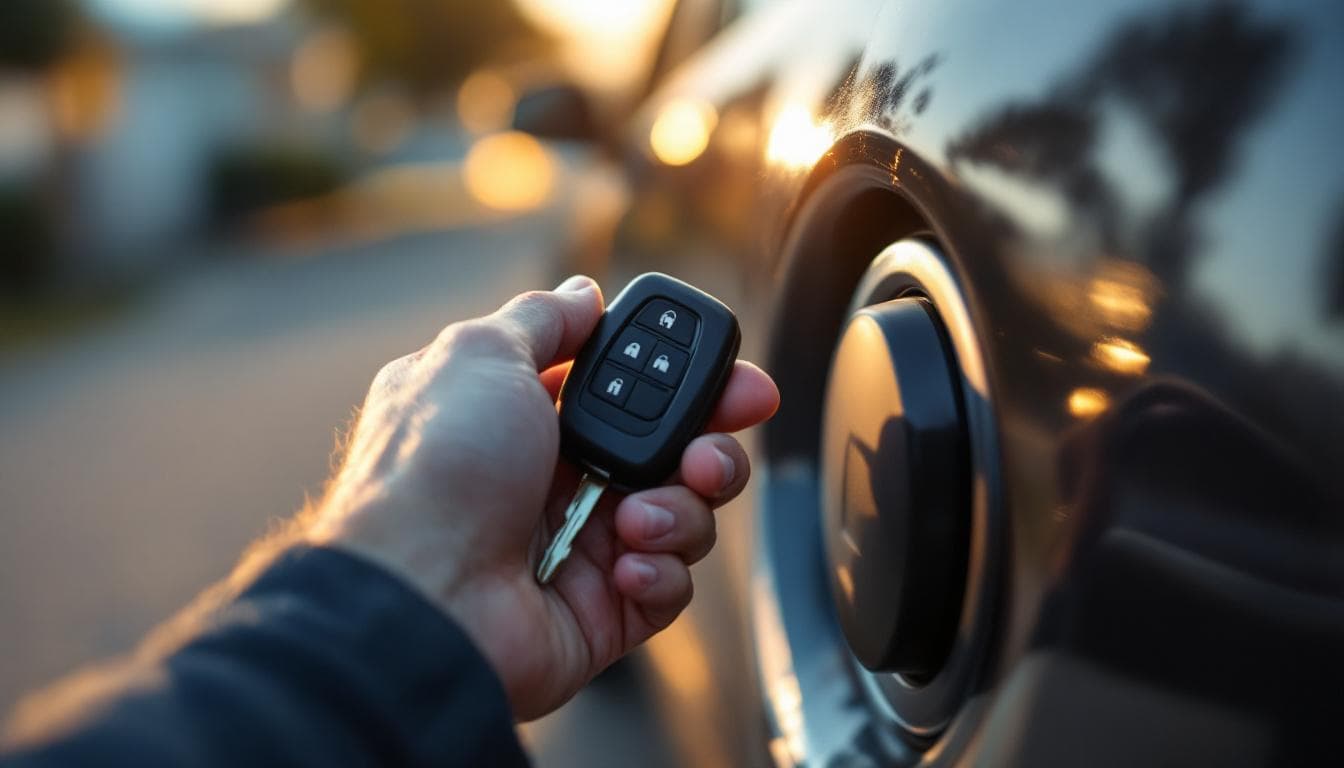
It is 9:45pm on a Friday. You have finished a long week, you are loaded down with groceries from Stater Bros., and you close the car door before realizing — with complete certainty — that your keys are sitting right there on the passenger seat.
This scenario plays out thousands of times every week across the Inland Empire. Grocery store lots in Redlands, the Costco in Fontana, the Walmart on Baseline in San Bernardino, Victoria Gardens in Rancho Cucamonga — these are among our highest-volume lockout locations. We respond to them every single week.
The near-universal truth: car lockouts are almost always preventable. These seven habits eliminate virtually all lockout risk.
Tip 1: Always Have a Spare Key — And Store It Somewhere Useful
This is the single most impactful thing you can do. A spare key costs $75–$175 depending on your vehicle. That one-time investment prevents a $65–$125 lockout call plus lost time and stress.
The critical detail is where you store it:
Effective locations:
- With a trusted family member or close friend who can reach you
- In a weatherproof magnetic key box secured to the vehicle's frame (metal/transponder keys only)
- In a fireproof home safe or secure lockbox
Locations that fail when you need them:
- In your purse or bag that is also inside the locked car
- On the same keyring as your primary key
- Under the floor mat — no access if the car is locked
- At your office miles away
Smart key owners: Do not store smart key spares in a magnetic box on the vehicle. The proximity signal can unintentionally unlock the car or drain the battery. Keep smart key spares indoors only.
Tip 2: The Three-Second Key Check
Establish one consistent leaving-the-car routine and it becomes automatic — executing correctly even when you are tired and distracted.
Before closing your door, physically touch three items in sequence: keys — phone — wallet. Confirm each is on your person. Then close the door.
This habit is used by pilots, military personnel, and emergency responders because physical confirmation overrides mental shortcuts. After three weeks of practice, your brain executes this routine automatically.
Tip 3: Save Our Number in Your Phone Right Now
Not during the lockout while your battery is at 8% and you are stressed. Now, with a clear head.
Save (909) 935-8844 as "Locksmith — Lock Busters" in your contacts today. When you need a locksmith, you will call a licensed, verified business — not whatever ad appears first in a panicked Google search.
Many callers spend 10–20 minutes searching for a locksmith during a lockout, sometimes landing on scam operations. That entire problem is eliminated with one 10-second contact entry right now.
Tip 4: Activate Your Vehicle's Connected Services
If your car was made after 2017, it likely has remote unlock capability through a connected app:
- Toyota: Toyota Connected Services
- Ford / Lincoln: Ford Pass / Lincoln Way
- GM (Chevy / GMC / Buick / Cadillac): OnStar
- BMW: BMW ConnectedDrive
- Hyundai / Kia: Blue Link / Kia Access
- Honda: Honda Link
Check whether your subscription is active right now. Many trial periods expire without notification. Renewal is $5–$20/month — less than one lockout call per year. This resolves the most common lockout (keys visible inside) at zero cost.
Tip 5: Know the High-Risk Moments
Our dispatch data shows clear patterns in when and where lockouts happen across the Inland Empire:
Grocery store parking lots — hands full with bags, distracted, moving quickly. Highest-frequency lockout scenario. Slow down by ten seconds at the car door.
Gas stations — stepping out briefly, door auto-locks on many vehicles. Always confirm keys are on your person before stepping away.
School pickups — running to collect a child, leaving the car for 30 seconds, door locks itself.
Moving day — maximum distraction, dozens of trips between car and door, hands constantly full.
Hot days — IE summer heat (regularly 100–110°F) causes rushed exits to reach air conditioning. One extra breath prevents the lockout.
Tip 6: Never Attempt DIY Forced Entry
The impulse to grab a coat hanger and YouTube a solution is understandable — but modern door seals and weather stripping are precision-fitted components.
DIY entry attempts consistently cause:
- Torn weather stripping ($45–$120 to replace per door)
- Paint and door frame scratches (potentially $200–$600+ to repair)
- Damaged interior door mechanisms
The cost of that damage almost always exceeds Lock Busters' professional lockout fee of $65–$95. Wait 20–40 minutes for a professional. The math is not close.
Tip 7: Understand AAA vs. Mobile Locksmith Response Times
Both options are legitimate. The difference is time:
- AAA / Insurance Roadside: Covered cost if included in your plan. Average Inland Empire response: 45–90 minutes.
- Lock Busters: $65–$95. Average response: 20–40 minutes.
In summer heat with a child or pet in the car, the time difference matters significantly. In a safe, comfortable situation where coverage eliminates cost, roadside assistance is a reasonable choice.
If a Lockout Happens Anyway
The correct action sequence:
- Try the connected services app first — free if subscription is active
- Call a spare key holder — free
- Call Lock Busters at (909) 935-8844 — $65–$95, 20–40 min
- Call roadside assistance — covered, 45–90 min
Avoid breaking windows (expensive and creates hazards) and DIY wire tools (damages weather stripping every time).
The best lockout plan is built before you ever need it. Start with a spare key and one saved contact.
What the Industry Data Says
Roadside-service call data gives a clear picture of how common car lockouts actually are. AAA's most recent roadside-services briefing reports that the organization responds to more than 4 million lockout calls in the U.S. each year, making lockouts one of the top three reasons drivers request emergency assistance[^aaa-roadside-stats]. The National Highway Traffic Safety Administration tracks heat-related vehicle incidents separately and notes that ambient cabin temperatures in parked cars can climb 30 to 40°F above outside air within 30 minutes — a meaningful factor in San Bernardino County between June and September[^nhtsa-heat]. The Insurance Institute for Highway Safety has documented that smart-key proximity systems, which now ship standard on roughly 80 percent of new vehicles sold in the U.S., have a measurably different lockout failure mode than traditional keys: most "lockouts" with proximity systems are actually dead-fob or signal-interference events, not user error[^iihs-keyless].
"The single most preventable lockout is the one where the spare key never got cut. When I ask new customers whether they have a spare on file, fewer than half do. It's the cheapest insurance in automotive."
— Bret Schwartz, contributing writer, Locksmith Ledger International
Smart-Key-Specific Habits Most Drivers Skip
Smart keys behave differently from traditional transponders, and most published lockout-prevention advice was written before proximity systems became standard. Three habits specific to push-to-start vehicles:
- Replace your fob battery on a schedule, not on failure. Most CR2032-powered fobs lose meaningful signal range at roughly 18 to 24 months. A weak fob will sometimes start the car but fail to lock or unlock, especially in cold weather or near competing 315/433 MHz signals.
- Store spare smart keys at least 15 feet from the vehicle. A smart-key spare on a kitchen hook near the garage can occasionally maintain a proximity handshake with the car overnight, draining the vehicle battery and (in some models) firing the trunk-pop or windows-down convenience features unintentionally.
- Know whether your model has a manual key blade hidden in the fob. Most smart-key fobs contain a mechanical emergency blade that opens the driver's door if the fob dies. The procedure to remove the blade varies by brand — practice it once, not for the first time at 11 p.m. in a parking lot.
Inland Empire–Specific Prevention
The IE's geography and weather create lockout-risk patterns that differ from coastal Southern California. The Fontana, Rialto, San Bernardino, and Redlands corridor sees consistent 100°F+ summer temperatures, which means lockouts with a child or pet in the vehicle are genuine medical emergencies, not inconveniences. Save Lock Busters as (909) 935-8844 in your favorites list now — search-and-call from a stranger's phone at the side of the 215 is not the time to vet a locksmith.
What to Do Right Now
- Get a spare cut today if you don't have one. A duplicate visit while you have a working original costs $110 to $200 — roughly half the all-keys-lost rate.
- Add Lock Busters to your phone favorites. (909) 935-8844, CA License #LCO 7776. Verify the license at search.dca.ca.gov.
- Test your connected-services app this weekend. If your Toyota Connected, OnStar, FordPass, MyChevrolet, or BMW ConnectedDrive subscription is lapsed, you may not know until you need it.
Sources
[^aaa-roadside-stats]: AAA Newsroom — annual roadside-services briefings, https://newsroom.aaa.com/
[^nhtsa-heat]: National Highway Traffic Safety Administration — "Heatstroke" / vehicle heat safety, https://www.nhtsa.gov/campaign/heatstroke
[^iihs-keyless]: Insurance Institute for Highway Safety — Anti-theft topic, https://www.iihs.org/topics/anti-theft
Frequently Asked Questions
What is the most common cause of car lockouts?
Distraction — rushing with groceries, on a phone call, or mentally elsewhere when the car door closes. The three-second key check habit directly eliminates this scenario.
Does a magnetic key box under the car actually work?
Yes, for metal and transponder keys stored in a weatherproof box on the vehicle frame. Important: smart keys stored near the vehicle can trigger the proximity system unintentionally. Keep smart key spares indoors.
Can my phone unlock my car in an emergency?
Yes, if your vehicle has an active connected services subscription — Toyota Connected, OnStar, MyFord Mobile, BMW ConnectedDrive, etc. Check whether your subscription is still active today.
Is AAA worth having in the Inland Empire?
AAA provides real value for multiple roadside scenarios. Their lockout response averages 45–90 minutes in San Bernardino County. Lock Busters typically arrives in 20–40 minutes. Both are valid — know which fits your situation.
My car auto-locks — how do I prevent accidental lockouts?
The key check habit is essential for auto-lock vehicles. Also verify whether your manufacturer app allows remote unlock, and keep a spare with someone you can call quickly.