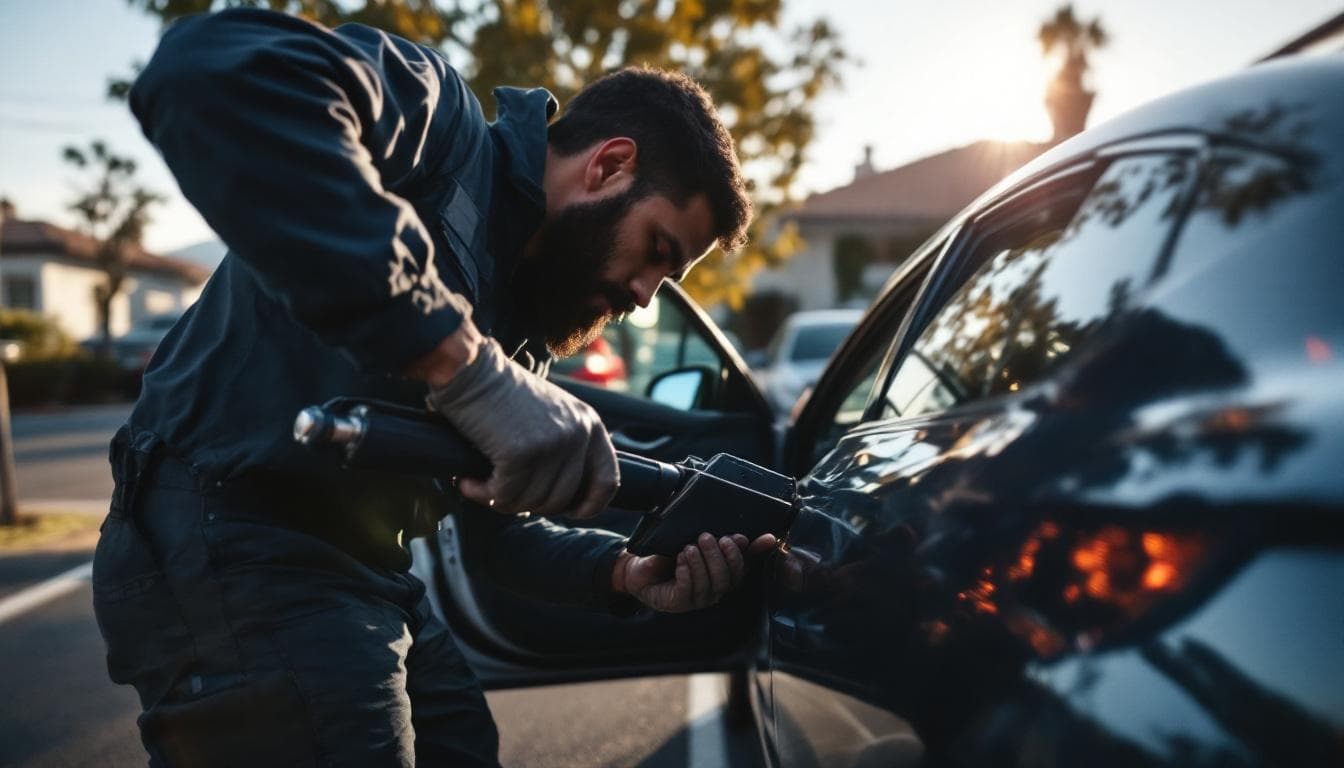
The locked-out-of-my-car feeling is universally unpleasant — a mix of frustration, self-directed irritation, and anxiety about logistics. If you have never dealt with it before, you may not know exactly what to expect when you call a locksmith.
This guide walks through the entire process so there are no surprises.
Step 1: Verify the Situation Before Calling
Before dialing, do a 60-second check:
- Try all doors. It sounds obvious, but passenger doors and rear doors are sometimes unlocked even when the driver door locks. Try all of them.
- Check your connected services app. Toyota Connected, OnStar, MyFord Mobile, BMW ConnectedDrive — if your car has an active subscription, tap "Remote Unlock" in the app. This is free and takes 10 seconds.
- Is there a spare anywhere? Is someone at home who could drive you a spare key? Even a 20-minute wait for a family member beats any service call cost.
If none of the above works, call (909) 935-8844.
Step 2: What Happens When You Call Lock Busters
When you call, our dispatcher will ask:
- Your exact location (address, nearest intersection, or business name)
- Vehicle year, make, and model
- Whether the keys are visible inside the vehicle
- Whether there is any urgency (child in vehicle, extreme heat, safety concern)
We provide you with an estimated arrival time and a confirmed price before dispatch. No surprises at invoice time.
Calls with special urgency — a child or pet locked in a hot vehicle — are immediately escalated to priority response. In these cases, also call 911. Emergency responders can break a window faster than any locksmith can arrive, and the window cost is always worth the safety outcome.
Step 3: The 25–40 Minute Wait — How to Stay Safe
Waiting in a parking lot or on a roadside has variables. Here is how to make that window safe:
Parking lot: Stay in a well-lit area. Move toward the building or toward other people rather than waiting at a remote corner of the lot. Call someone you trust and let them know your location and situation.
Roadside (surface street): Move away from traffic. If possible, wait on the sidewalk or grass, not between parked cars and the road. Turn on your hazard flashers if the vehicle is at a roadside.
Freeway shoulder: This is the highest-urgency scenario. Never wait on the freeway shoulder if you can avoid it. Call 911 to report your location, and CHP can provide traffic break coverage or call assistance. Then call us.
Hot weather: Inland Empire summer temperatures regularly hit 105–115°F. Find shade or enter a nearby air-conditioned business while you wait. Gas stations, fast food restaurants, and retail stores are generally happy to let you wait inside when you explain the situation.
Step 4: What Happens When the Locksmith Arrives
Our technician will:
Confirm your identity. For vehicle lockouts, we typically ask you to confirm the vehicle's VIN (visible through the windshield on the driver's side dash), describe items visible inside the car, or provide registration information. This is a security verification step.
Assess the vehicle. We identify the door mechanism type, weather stripping condition, and the best entry point for your specific vehicle.
Select the appropriate tools. Different vehicles require different approaches. We use:
- Long-reach tools for vehicles where a rod can reach the lock button or door handle
- Air wedge + long reach for vehicles requiring slight door gap creation
- Slim jim / bar tool for older vehicles with exposed lock rods
- J-tool for certain common door configurations
Open the door. On most common Inland Empire vehicles — Toyota Camry, Honda Civic, Ford F-150, Chevrolet Silverado, Dodge Ram — the process takes 2–6 minutes. Specialty vehicles or those with modified weatherstripping may take up to 10–12 minutes.
Verify everything is in order. We confirm the lock and door mechanism are functioning normally before leaving.
What a Car Lockout Costs — No Hidden Fees
Lock Busters' standard car lockout pricing:
- Standard car lockout: $65–$95
- All-in, no fuel surcharge, no hidden fees within standard service hours
If you call us and it turns out you actually need a new key rather than just an unlock (keys are not inside — they are lost), we will tell you immediately and quote the key replacement service separately. No dispatch fee is charged if we have not yet arrived.
The Zero-Damage Guarantee
Professional lockout service causes zero damage when performed correctly. We use non-marring tools, vehicle-specific approach angles, and techniques refined across hundreds of makes and models.
If you have seen videos of locksmiths jamming metal rods between doors and bending weather stripping — that is unprofessional technique, not standard practice. Lock Busters technicians are trained on non-destructive entry as the baseline, not the exception.
If for any reason incidental damage occurred during a service, our liability insurance covers it and we address it immediately.
After the Lockout: Three Things to Do
1. Make a spare key at the same appointment. While the locksmith is still present, ask about having a spare key made. Same-visit pricing is significantly discounted. A $100 spare today prevents the next lockout entirely.
2. Set up your connected services app. If your vehicle has connected services and you have not activated the app, do it today. The app remote unlock feature costs nothing to use once the subscription is active — and it eliminates the lockout scenario for future incidents.
3. Save Lock Busters in your contacts. (909) 935-8844 — CA License #LCO 7776. One entry today saves you a panicked search at the worst possible time.
What the Industry Data Says
Car lockouts remain one of the top three reasons U.S. drivers request roadside assistance, with AAA alone responding to more than 4 million lockout calls annually[^aaa-roadside-stats]. The National Highway Traffic Safety Administration tracks heat-related vehicle incidents and notes that interior cabin temperatures in parked vehicles can climb 30 to 40°F above ambient air within 30 minutes — a meaningful safety factor for lockouts in San Bernardino County summers[^nhtsa-heat]. ALOA Security Professionals Association classifies vehicle entry tools and techniques under a credentialed-technician framework, distinguishing between non-destructive entry (the only acceptable approach for a licensed locksmith on a customer's vehicle) and forced-entry methods that should never be applied to a paying customer's vehicle[^aloa-automotive].
"A licensed locksmith should never need to break a window, drill a lock, or damage trim to enter a customer's vehicle for a standard lockout. Non-destructive entry is the standard of care, and any technician who doesn't deliver that is operating below industry norms."
— Cliff Cline, automotive locksmith and contributor, Locksmith Ledger International
What to Do Right Now
- If a child, pet, or elderly person is locked in the vehicle in summer temperatures, call 911 first, then the locksmith. Cabin temperature is a real medical risk in IE summer conditions.
- Don't try to enter with a coat hanger or wedge. Modern vehicles have side-curtain airbags routed through the door frame; a hanger can fire an airbag and cause $1,500 to $4,000 in damage.
- Call (909) 935-8844 for non-destructive lockout service. 20- to 40-minute response across the IE. CA License #LCO 7776.
What a Real Lockout Service Looks Like, Step by Step
A non-destructive vehicle entry by a credentialed mobile locksmith follows a tightly defined sequence:
- Dispatch and ETA. You call (909) 935-8844, give your location, vehicle make/model/year, and the situation (keys visible inside, keys lost, child in vehicle, etc.). We confirm ETA — typically 20 to 40 minutes across the IE — and dispatch.
- Technician verification on arrival. The technician confirms your identity against the vehicle registration or insurance card and confirms the vehicle is yours. This step exists for legal reasons under California Penal Code §466.6 and applies even in stressful situations.
- Non-destructive entry. Using a long-reach tool, an air-wedge, and an entry-pick rod (the standard professional toolkit), the technician opens the door without damaging the weatherstripping, the paint, the side-curtain airbag wiring, or the door-frame.
- Confirmation that the vehicle starts. If the situation was "keys locked in vehicle," we confirm the engine starts before clearing the scene. If the situation was "keys lost," we typically follow up with an on-site key-replacement service unless you have made other arrangements.
- Payment and receipt. Card-on-site, written receipt, business-card with license number and contact info for follow-up.
The entire sequence runs 25 to 50 minutes in most cases. No tow, no dealer, no waiting room.
Why Coat Hangers, Wedges, and DIY Entry Are Bad Ideas
Three specific risks make DIY vehicle entry a worse idea than it looks:
- Side-curtain airbag deployment. Modern vehicles route the side-curtain airbag wiring through the door frame and the B-pillar. A coat hanger or wedge inserted along the door edge can sever a wire or fire the airbag, causing $1,500 to $4,000 in repair cost.
- Weatherstripping and trim damage. The rubber gasket along the door frame and the painted trim around the window can be torn or scuffed by improvised tools — visible cosmetic damage that survives the trip home.
- Window and door-handle damage. Pressure applied to the wrong point can crack the window glass, bend the door frame, or destroy the door-handle linkage. Repair cost can exceed the cost of a year's worth of legitimate lockout calls.
The professional toolkit is designed to apply force only at the few specific points on a vehicle where the door can be opened without damaging anything else. That's the actual product you're paying for.
Sources
[^aaa-roadside-stats]: AAA Newsroom — annual roadside-services briefings, https://newsroom.aaa.com/
[^nhtsa-heat]: NHTSA — Heatstroke campaign and vehicle heat safety, https://www.nhtsa.gov/campaign/heatstroke
[^aloa-automotive]: ALOA Security Professionals Association — Automotive Division, https://www.aloa.org/
Frequently Asked Questions
How long does it take a locksmith to unlock a car in the Inland Empire?
Lock Busters' average response time is 25–40 minutes across the Inland Empire. The actual door opening takes 2–8 minutes once we arrive, depending on vehicle type and door mechanism.
Will a locksmith damage my car when opening it?
A professional locksmith using proper tools causes zero damage to weather stripping, door frames, or glass. We use non-marring slim jim tools and air wedge techniques specific to your vehicle model. Damage-free entry is standard — not exceptional.
How much does a car lockout service cost in the Inland Empire?
Lock Busters charges $65–$95 for standard car lockout service in the Inland Empire. This is all-inclusive — no fuel surcharge, no after-hours premium within standard hours, no hidden fees.
What if my keys are not locked inside — I just lost them?
If your keys are lost rather than locked inside, you need key replacement rather than lockout service. Lock Busters can make a new key on-site for most vehicles. This is a different service at a different price point — call us and we will clarify which service you need.
Is it safe to wait for a locksmith in a parking lot at night?
Stay in a well-lit area visible to other people. Call someone you trust to keep you company on the phone. If you feel unsafe, move to a nearby open business (gas station, restaurant) and wait there. We will come to you.