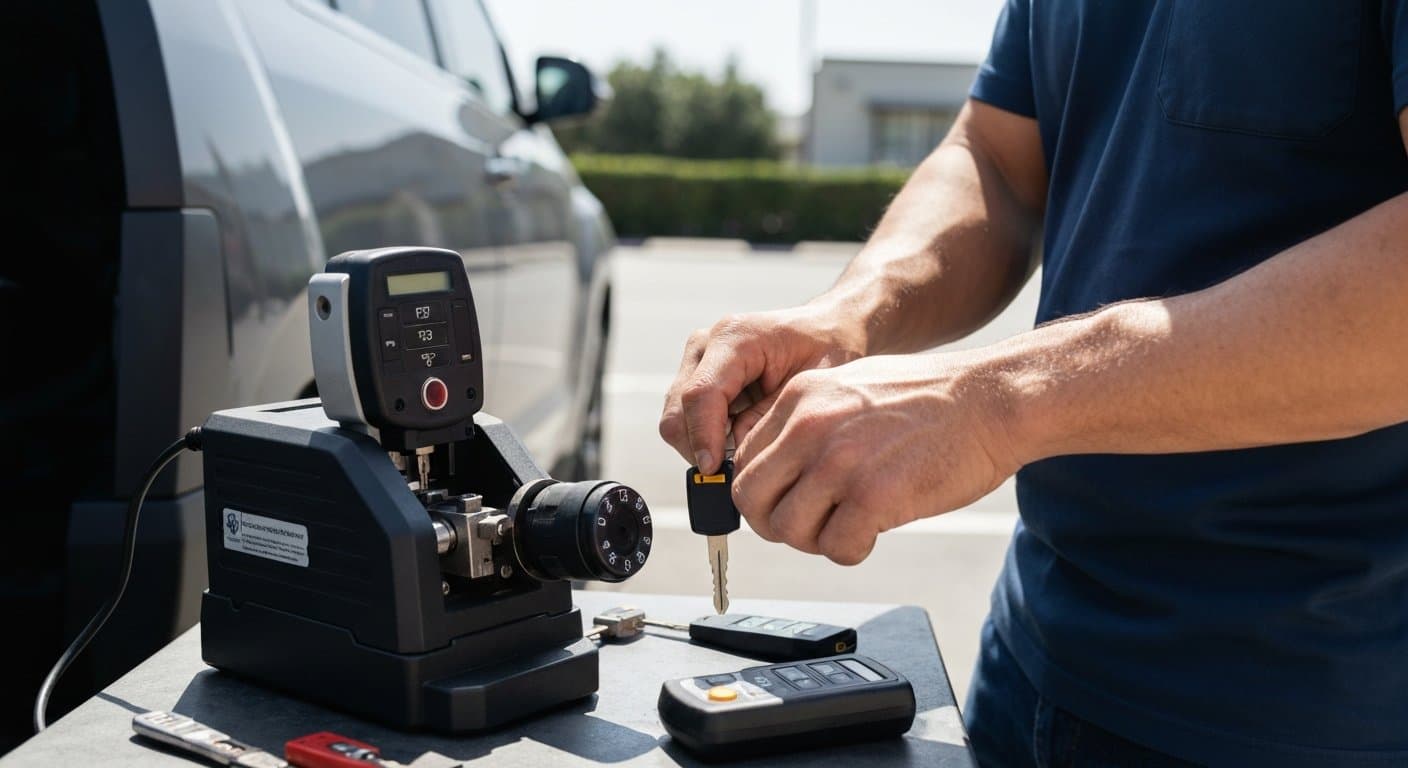
Losing your only car key in San Bernardino is the kind of problem that stops your whole day. Whether you are stranded in a parking lot off Hospitality Lane or staring at an empty key hook at home in the morning, the questions are always the same: what will a replacement cost, how long will it take, and do you really have to tow the car to the dealership? This guide answers those questions with real price ranges for the Inland Empire and a clear explanation of how modern car key replacement actually works.
How Much Does Car Key Replacement Cost in San Bernardino?
The honest answer is that price depends heavily on what kind of key your vehicle uses. Modern vehicles use several distinct key technologies, and each carries a different cost to cut and program:
- Basic metal (non-transponder) key: roughly $50 to $120. These are limited to older vehicles, generally pre-1998.
- Transponder (chip) key: roughly $120 to $250, because the chip must be programmed to your vehicle's immobilizer.
- Remote head key (key + integrated fob): roughly $150 to $325.
- Smart / proximity (push-to-start) key fob: roughly $250 to $500+, and luxury or European models can run higher.
These ranges align with national replacement data. The American Automobile Association has reported that replacing a modern smart key can cost several hundred dollars once the fob hardware, cutting, and programming are combined — a sharp increase over the simple metal keys of two decades ago. The reason is straightforward: since the late 1990s, nearly every new vehicle ships with an electronic immobilizer that refuses to start unless it recognizes a programmed key. The National Insurance Crime Bureau has credited immobilizer technology with contributing to long-term declines in vehicle theft rates, which is exactly why the keys are now small computers rather than cut brass.
"The transponder immobilizer is one of the most effective anti-theft technologies ever deployed in passenger vehicles. The trade-off for the consumer is that a lost key is no longer a trivial replacement."
— National Insurance Crime Bureau, public guidance on vehicle anti-theft systems
What Drives the Price Up or Down?
Three factors explain most of the variation in any quote:
- Key technology. As above, a proximity fob costs several times what a chipped metal key costs because the hardware itself is more expensive and the programming is more involved.
- Whether you have a working key. If you still have one functioning key, a locksmith can usually clone or add a spare quickly and affordably. If all keys are lost, the locksmith must put the vehicle into a special programming mode, which takes longer and costs more.
- Vehicle make and model. Mainstream brands like Toyota, Honda, Ford, and Chevrolet are well-documented and quick to program. Luxury and European marques — BMW, Mercedes, Audi, Land Rover — often require dealer-level tooling and can cost two to three times as much.
Mobile Locksmith vs. Dealership: Which Is Better?
For most San Bernardino drivers, a mobile automotive locksmith is the faster and more affordable option. Here is the honest comparison.
The dealership is the right call in a narrow set of cases: very new models in their first year or two of production, certain high-security European vehicles, and situations where a key is bundled with a warranty repair. The downsides are real, though. You typically must tow the vehicle to the dealer (because a lost-all-keys car cannot be driven), wait for a parts order, and pay dealer labor rates. The Federal Trade Commission's consumer guidance on auto repair routinely reminds drivers to compare estimates precisely because dealer pricing tends to sit at the top of the market.
A mobile locksmith, by contrast, comes to wherever your car is — your driveway, a grocery-store lot, your workplace — and cuts and programs the key on-site. For the large majority of vehicles on the road in the Inland Empire, this is both cheaper and dramatically faster. There is no tow, no multi-day parts wait, and no need to rearrange your life around a service-department appointment.
How Long Does It Take?
Timing depends on the same factors as price. Realistic expectations:
- Spare key when you have a working key: often 15 to 30 minutes on-site.
- Transponder or remote key, all keys lost: typically 30 to 60 minutes, including the immobilizer programming sequence.
- Smart/proximity fob, all keys lost: 45 to 90 minutes for most mainstream vehicles; longer for some luxury models.
A mobile locksmith carries the key blanks, cutting equipment, and programming tools in the van, which is why same-day — often same-hour — service is realistic in San Bernardino and across the Inland Empire. A dealership process that involves towing and ordering parts can stretch to several days.
What to Do the Moment You Lose Your Car Key
Acting methodically saves both money and stress:
- Confirm it is truly lost. Check your usual spots, jacket pockets, and bags. A surprising share of "lost key" calls end with the key turning up in a coat.
- Locate your VIN. The 17-character Vehicle Identification Number is on the dashboard at the base of the windshield and inside the driver's door jamb. A locksmith needs it to source the correct key.
- Know your year, make, and model. This determines the key type and the quote.
- Decide on location. A mobile locksmith can meet you at the vehicle, so you do not need to move a car you cannot start.
- Call for a quote that includes everything. Ask whether the price includes the key hardware, cutting, programming, and the service call so there are no surprises.
Do You Need the Title to Replace a Car Key?
You do not necessarily need the physical title, but a reputable locksmith will verify that you are the lawful owner before cutting and programming a key. Expect to show a government-issued ID and proof of ownership or registration matching the vehicle. This is a standard anti-theft safeguard, and you should be wary of any service willing to skip it — the verification protects you as much as it protects the locksmith.
Why "All Keys Lost" Costs More
When you have a working key, the vehicle's computer already trusts an existing credential, so adding another is quick. When every key is gone, the locksmith must establish a brand-new trust relationship with the immobilizer from scratch. On many vehicles this requires a security wait timer, special access to the onboard computer, or pulling and reading data from a module. That additional labor — and occasionally additional equipment — is why an all-keys-lost job sits at the higher end of the range. It is also why keeping a spare is one of the best-value decisions a car owner can make: a spare cut today is far cheaper than an emergency all-keys-lost replacement later.
Avoiding Car Key Replacement Scams
Most locksmiths are honest, but a few predatory operators advertise an unrealistically low "starting at" price and then inflate the bill on-site. Protect yourself with a few habits. Get the full out-the-door price before work begins. Confirm the business has a real local presence and reviews. Be cautious of unbranded vehicles and quotes that seem far below every other estimate — a $15 lockout ad that becomes a $300 invoice is a classic bait-and-switch the FTC has warned consumers about for years. A trustworthy locksmith will give you a clear, itemized quote and stand behind it.
Frequently Asked Questions
How much does it cost to replace a lost car key in San Bernardino?
For most vehicles, expect $120 to $250 for a transponder key and $250 to $500 or more for a smart/proximity fob. A basic non-transponder key for an older vehicle can be under $120. Luxury and European models cost more because they require dealer-level programming tools.
Can a locksmith make a car key without the original?
Yes. A qualified automotive locksmith can create a key even when all keys are lost, by reading the vehicle's immobilizer data and programming a new key to it. This costs more than copying an existing key because of the extra labor involved, but it avoids a tow to the dealership.
Is a mobile locksmith cheaper than the dealership?
For the large majority of vehicles, yes. A mobile locksmith avoids the tow, the parts-order wait, and dealer labor rates, and comes to your location. Some very new or high-security European models still require the dealer.
How long does car key replacement take?
A spare key when you have a working key takes about 15 to 30 minutes. An all-keys-lost transponder or smart-key job typically takes 30 to 90 minutes on-site, depending on the vehicle.
Do I need proof of ownership to get a replacement key?
Yes. A reputable locksmith will check a government-issued ID and proof that you own the vehicle before cutting and programming a key. This is a standard anti-theft step, and you should avoid any service that skips it.